A suite or a hotel room?
Both are good ways to stay in Kigo, and the right answer changes with the length of the trip and the number of people on it. Here is the comparison line by line.
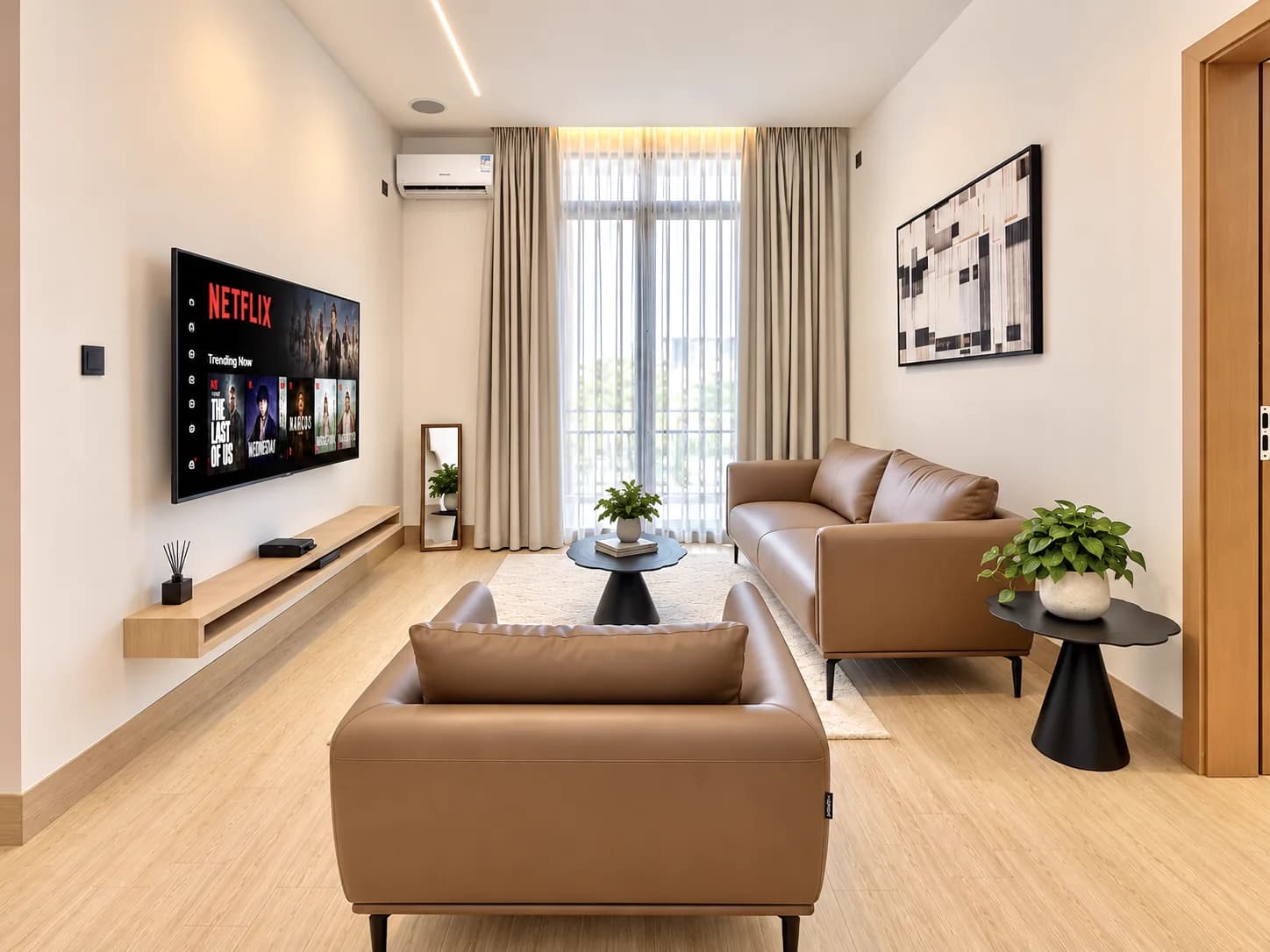
A serviced apartment or a hotel room in Kigo?
For one or two nights on your own, book a hotel room: it is simpler, you are not paying for a kitchen you will never open, and a front desk is all the service a stopover needs. For three nights or more, or for more than two people, a serviced apartment usually wins on both space and cost.
The reason is structural rather than a matter of taste. A hotel sells rooms, so a family of four normally means two of them; an apartment sells the whole space, so four people share one rate, one kitchen and one lounge, and the arithmetic changes with every extra night.
How much more space do you actually get?
Enough to stop a trip feeling like a queue for one room. The smallest apartment here, the Studio Deluxe, starts at 32 m²; the 1BHK Suite starts at 52 m², the 2BHK Suite at 88 m² with two bathrooms, and the 3BHK Penthouse at 180 m² across the top floor.
Privacy is the part guests underestimate. In a hotel room, one person reading at midnight is in the same room as one person sleeping; in the 1BHK Suite and above, the bedroom door closes on a separate lounge, and in the 2BHK Suite each king bedroom has its own bathroom.
HMK Living and a traditional hotel.
A hotel room is built for sleeping; a serviced apartment is built for staying. The left column is what HMK Living includes in Kigo; treat the right-hand column as the usual picture rather than a rule, because hotels differ.
| Feature | HMK Living apartment | Typical hotel room |
|---|---|---|
| Space | From a 32 m² studio to a 180 m² three-bedroom penthouse, with a separate lounge in every apartment above the studio | One room, sometimes with a chair and a small table in the corner |
| Privacy | Your own front door; bedrooms close behind a door, so one guest can work while another sleeps | A single room shared by everyone staying in it |
| Kitchen | A kitchenette in the Studio Deluxe and 1BHK Suite; a full kitchen in the 2BHK Suite and the 3BHK Penthouse | Usually none, so every meal is bought |
| Laundry | Laundry and ironing run for you as a service, collected from and returned to the apartment | A laundry service, priced per item on most rate plans |
| Breakfast | Included with every stay, in the ground-floor restaurant | Included on some rates, charged on others |
| Lunch and dinner | À la carte from the same kitchen, as room service, or cooked yourself | Restaurant or room service only |
| Two people a night | One apartment covers both — the Studio Deluxe from $105, the 1BHK Suite from $115 | One double room at that property's nightly rate |
| Four people a night | The 2BHK Suite from $200 sleeps four across two king bedrooms with two baths — one rate, one bill | Usually two rooms, so roughly twice the nightly rate |
| A week or longer | Stays of seven nights or more carry a 10–20% discount, and the concierge quotes monthly rates | Long-stay terms vary; many properties price by the night throughout |
| Working | A work desk in every apartment and fibre-optic mesh Wi-Fi throughout the building | A desk in the bedroom, or a shared business centre |
| Service | 24/7 guest concierge, daily housekeeping and room service | Front desk, housekeeping and room service |
| Security | 24/7 armed security on site and gated parking | Varies by property |
| Booking and payment | Book on the website, nothing charged at booking, settled on arrival, free cancellation up to 48 hours before check-in | A card is usually taken at booking; cancellation terms depend on the rate |
Four apartments, one standard.
Headline Bed & Breakfast rates, per night. Stays of seven nights or more enjoy a 10–20% discount.
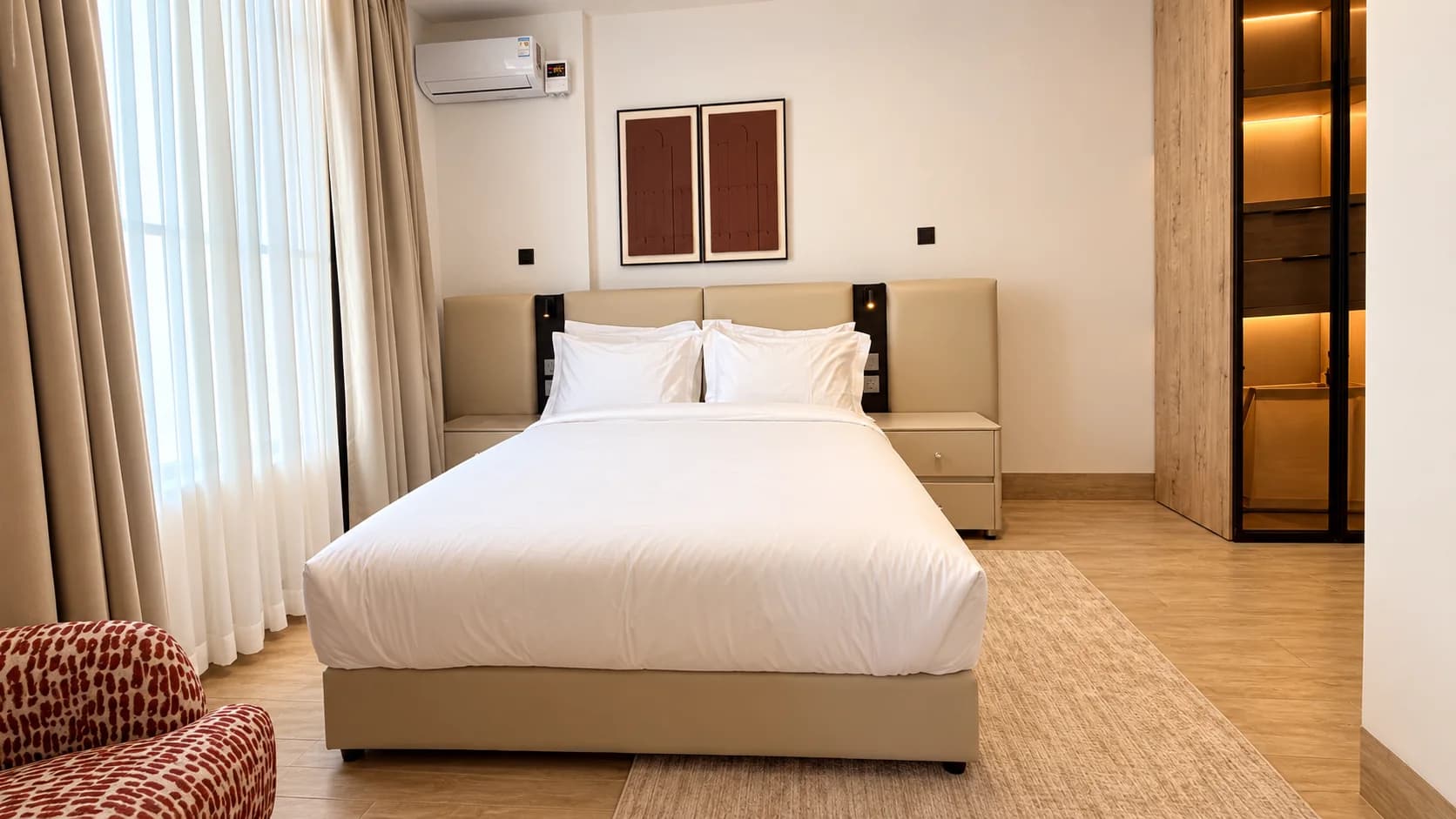
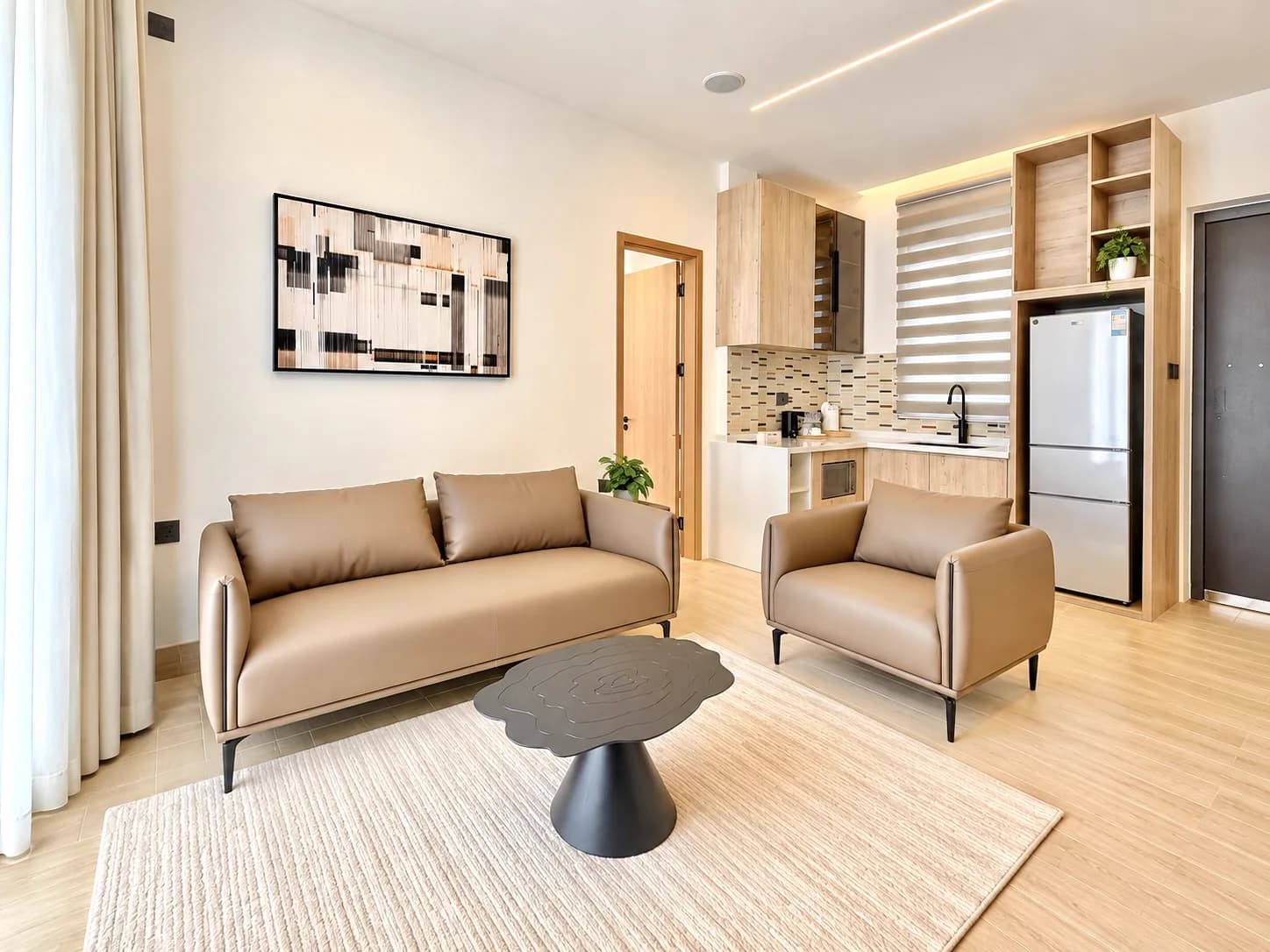
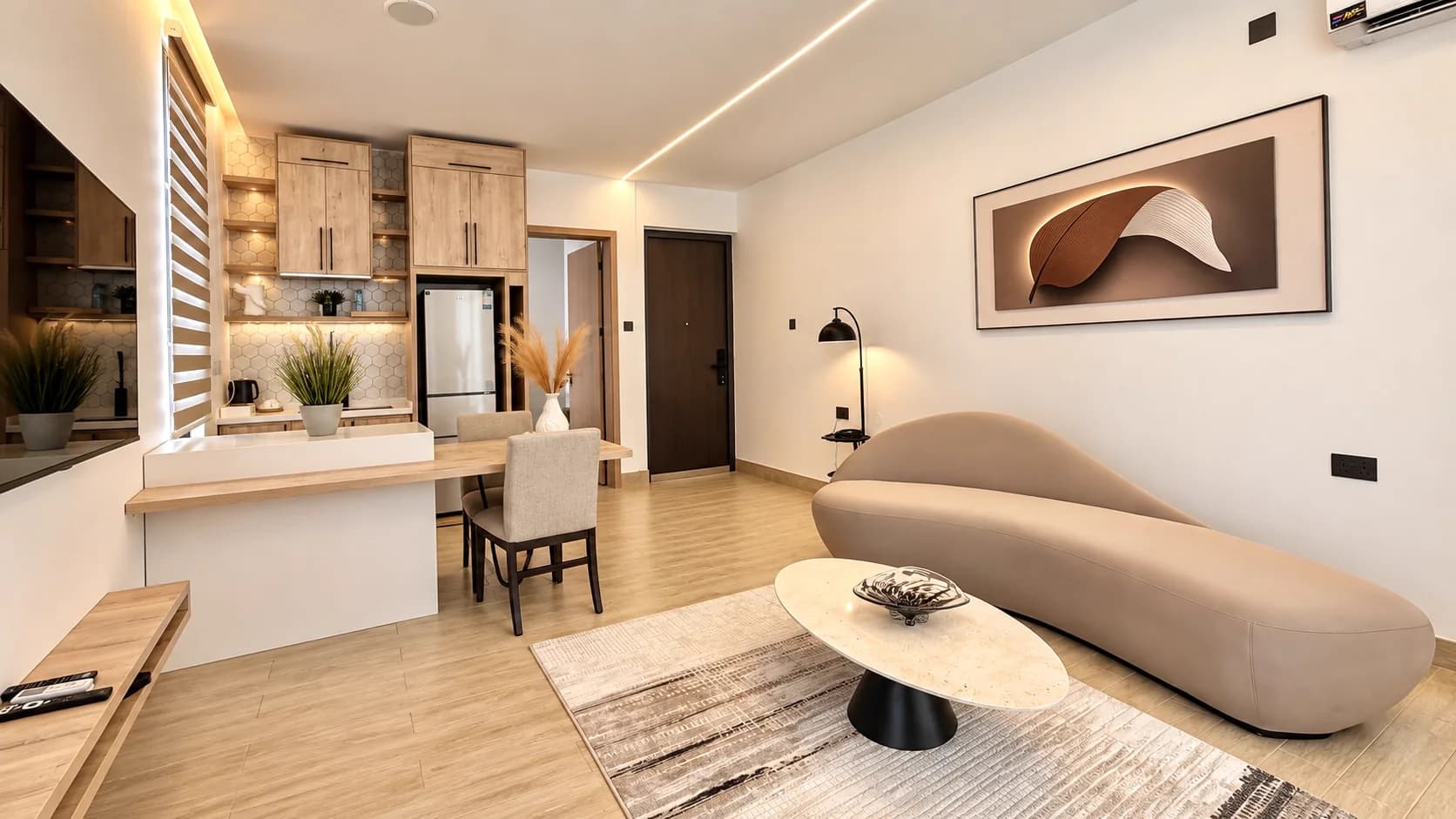
Which works out cheaper for two or four people?
For two people the options are close, and the deciding factor is usually what you want rather than what you pay: the Studio Deluxe from $105 a night or the 1BHK Suite from $115, breakfast included in both, against one hotel room at that property's rate.
For four people the gap opens up. The 2BHK Suite starts at $200 a night and sleeps four in two king bedrooms with two bathrooms and a shared lounge — a single rate where a hotel would normally sell you two rooms and two breakfasts.
Then add the things that are not on the rate line. Breakfast is already in the price, lunch and dinner can be cooked rather than ordered, and a stay of seven nights or more takes 10–20% off — three effects that compound over a fortnight and barely register over one night.
When is a hotel the better booking?
When the stay is short and the day is tight. For a single night between flights at Entebbe, a hotel room is the cleaner choice: you sleep, you shower, you leave, and nothing about a kitchen or a lounge has earned its cost.
When you want resort facilities in the price of the room rather than next door to it. A full-service resort puts restaurants, bars, grounds and leisure under one roof and bills it as one stay, and the Lake Victoria championship golf resort beside us is exactly that kind of property.
When is an apartment the better booking?
When the stay runs past about three nights, or when more than two people are on it. Those two thresholds are where the extra space and the single rate start paying for themselves rather than sitting unused.
It also wins when a trip mixes work with everything else: calls from a proper desk on fibre-optic mesh Wi-Fi, a bedroom door you can close at 10:00 PM, laundry that comes back ironed, and breakfast you need not think about.
And it wins for families and for teams sharing a booking. Two colleagues in a 2BHK Suite each get a bedroom and a bathroom and share a lounge instead of texting each other between two rooms on different corridors.
What do you give up by choosing an apartment?
Four honest things. There is no swimming pool on the property; the Studio Deluxe and the 1BHK Suite have a kitchenette rather than a full kitchen, so serious cooking means booking the 2BHK Suite or the Penthouse; there are no washing machines in the apartments, as laundry is run for you as a service; and golf, spa and chauffeur access depend on the activity tier attached to your stay rather than coming with every rate.
There is also the location to weigh. Kigo is a quiet lakeside neighbourhood about 20 km by road from Entebbe International Airport and roughly a 25-minute drive from central Kampala, which is the right trade for sleep and wrong for anyone who wants to walk out to a different restaurant every night.
How long a stay tips the balance?
Around the third night, in most cases. One night favours a room, two nights are a coin toss, and from the third night the kitchen, the lounge and the laundry service start getting used often enough to matter.
At a week, the pricing moves as well: stays of seven nights or more carry a 10–20% discount, so the longer booking is also the cheaper one per night. Past a month, the concierge quotes monthly rates and a stay in Kigo starts to look like an address rather than a trip.
Still unsure? Ask before you book.
Tell the concierge the shape of the trip — how many nights, how many people, whether anyone needs to work — and they will say which apartment fits, or say plainly that a hotel room would serve you better for that particular stay.
The WhatsApp concierge is on +256 748 390 401 and the office line is +256 393 101 080. Booking direct on the website is where the long-stay discount, the activity tier and the 48-hour free cancellation all apply.
Choosing how to stay.
The questions guests ask when deciding between an apartment and a hotel room in Kigo.
It depends on the length of the stay and the number of people. For one night alone, a hotel room is simpler and cheaper. From about the third night, or for more than two people, an apartment wins on space and usually on cost, because it adds a kitchen, a lounge and a single rate for everyone in it.
Stay in an apartment, keep the service.
Tell us your dates and the apartment that suits — the founder-led team, and the agentic WhatsApp concierge, take it from there.