Kampala or Kigo: Where Should Business Travellers Actually Stay?
A decision guide for business travellers choosing between a central Kampala hotel and a quiet lakeside base in Kigo, 25 minutes out — the airport run, the traffic windows, meeting logistics, working conditions and what a week really costs.

Every business trip to Uganda eventually produces the same argument, usually in an email thread with a travel desk. Stay in the middle of Kampala and be close to the meetings, or stay out on the lake at Kigo and be close to the airport and the quiet. Both answers are defensible. Only one of them is right for your particular itinerary, and the deciding factor is almost never the one people argue about.
It is not the nightly rate. It is the number of times your trip touches Entebbe International Airport, and how many of your commitments are genuinely fixed inside the city.
This guide works through that decision properly: the geography, the traffic windows, the airport arithmetic, what a working day looks like from each base, how to run city meetings from 25 minutes out, and a worked week with the movements counted.
What is the real distance between Kigo and central Kampala?
Roughly 25 minutes by road in normal conditions, and about 20 km from Kigo to Entebbe International Airport via the Entebbe Express Highway. Those two figures are the whole geography of this decision.
Kigo sits on Kigo Road in Wakiso District, on the Lake Victoria shore south of the city, adjacent to the Lake Victoria championship golf resort with a wellness spa next door. Central Kampala — Nakasero, Kololo, Parliament Avenue, the ministries and most head offices — lies north of it. The airport is west, down the lake.
What changed Kigo's position in the market was the expressway. Before it, anywhere south of the city meant inheriting Kampala's traffic on every airport run. The highway bypasses the city centre, so the airport drive and the city drive are two separate journeys that do not share congestion. A central hotel has the opposite arrangement: short to the meetings, long and unpredictable to the plane.
That is the trade in one sentence. Central Kampala shortens your meetings commute and lengthens your airport run. Kigo does the reverse.
When should you stay in central Kampala?
Stay central when your diary is full of fixed, early, in-person commitments inside the city on consecutive days. Proximity beats everything else in that scenario, and no amount of comfort compensates for a 7:00 AM start on the far side of a commute.
The clearest cases:
- A one- or two-night trip built around a single meeting block. You land, you sleep, you present, you leave. Nothing about a lakeside base improves that.
- Three consecutive mornings of 8:00 AM meetings in Nakasero or Kololo. Three inbound peak-hour runs is the one pattern that makes a Kigo base genuinely tiring.
- Ministry, regulator or embassy work. These appointments move, get rescheduled at short notice and sometimes run into each other. Being ten minutes away absorbs that churn.
- Evening networking that runs late, every night. If your trip is really a series of dinners in Kololo, sleep near the dinners.
- A trip where somebody else controls your schedule. If you cannot cluster your meetings, you cannot use the Kigo pattern, because the pattern depends on clustering.
The costs of staying central are the familiar ones, and they compound with the length of the stay. Traffic noise. Rooms sized for sleeping rather than working. A desk that is really a console table. No kitchen of any kind. And an airport run that, from the Nakasero side, is the least predictable stretch of road on the itinerary.
For a two-night trip, none of that matters. By night five, most travellers start counting.
When is a Kigo base clearly better?
Choose Kigo when the airport appears more than once in your trip, when most of your working day happens on a laptop, or when the stay runs beyond about four nights. Those three conditions cover a surprisingly large share of modern business travel to Uganda.
The specific patterns Kigo suits:
- Fly-in, fly-out within the same week. Two expressway runs instead of two city crawls. On a trip with a tight connection at the far end, predictability is worth more than minutes.
- A regional role with repeat visits. If you are in Kampala monthly, the base you can work from matters more than the one you can walk from.
- Remote-heavy weeks. Calls with Europe in the late afternoon, calls with Asia early, calls with North America late at night. All of those happen at a desk, and the desk is what you are booking.
- Stays over four nights. This is where a separate lounge, laundry handled as a service and a long-stay rate change the arithmetic.
- Two colleagues travelling together. A 2BHK Suite, from 88 m² with two kings and two baths, books as one apartment rather than two hotel rooms.
- A principal with staff, or a trip that includes hosting. The 3BHK Penthouse, from 180 m² on the top floor with three kings, three baths and dining for ten, does a job no hotel room does.
- Trips where sleep quality is load-bearing. A residential lakeside setting at night is quieter than any address inside the city, and a negotiation goes better on seven hours than on five.
There is one more pattern worth naming because it is now common: the traveller whose Kampala trip is really two trips bolted together. Three days of meetings, then four days of focused work before flying home. Central for the first half is defensible. Central for the second half wastes the second half.
How does Kampala traffic actually shape the day?
Kampala traffic is directional and time-boxed rather than constant, and once you know the windows you can plan around them. The mistake visitors make is treating congestion as a fixed tax on every journey.
| Window | Direction | Practical effect |
|---|---|---|
| Before 7:30 AM | Inbound to the city | Close to the 25-minute figure |
| 8:00 AM – 9:30 AM | Inbound to the city | The worst inbound stretch; add a buffer |
| 12:00 PM – 4:00 PM | Both | Generally manageable in both directions |
| 5:00 PM – 7:00 PM | Outbound from the city | The worst outbound stretch |
| After 7:00 PM | Both | Clear, and the drive back to Kigo is easy |
Read down that table and the Kigo playbook writes itself. Leave before 7:30 AM for a morning block. Do not accept a 9:00 AM meeting that requires leaving at 8:15 AM. Put your own movements in the midday band. And if a dinner runs past 7:00 PM, you have accidentally chosen the best hour of the day to drive home.
The opposite applies to the airport. Entebbe runs from Kigo are on the expressway, which is not subject to those windows in the same way. That is the single most useful thing about the location, and the reason the arithmetic below works.
What does the airport run do to the arithmetic?
The airport is where a Kigo base pays for itself, because it is the one journey on a business trip with a hard deadline attached. Kigo is about 20 km from Entebbe International Airport on the expressway, and the road does not pass through the city.
Consider a trip with two airport transfers and six city meetings.
Staying central. Two airport runs that cross or skirt the city, both exposed to whatever the day is doing, both requiring a generous buffer because missing a flight is not recoverable. Six meetings, each of them a short hop. Total exposure to unpredictability: concentrated on the two journeys that matter most.
Staying in Kigo. Two airport runs on the expressway, booked against the flight number, with the concierge handling the pickup. Six meetings clustered into two or three city trips, each run outside the peak windows. Total exposure: spread across journeys where being twenty minutes late is survivable.
That is the real argument, and it is about risk rather than minutes. A central base puts the variance on the flights. A Kigo base puts the variance on the meetings, where you can absorb it by clustering and by leaving early.
One practical note that gets forgotten: ask for the transfer to be booked against the flight number, not the scheduled landing time. Flights into Entebbe move. A transfer tracked against the flight is waiting when you clear the terminal; one booked against a time is either early or gone.

How do you run city meetings from 25 minutes out?
Cluster them, use the drive, and host what you can at your own base. Those three habits turn the commute from a cost into a schedule.
Cluster ruthlessly. Three meetings on one morning is one round trip. The same three meetings spread across three days is three round trips, and that difference — not the distance — is what makes people say an out-of-town base does not work. When you send availability, offer blocks rather than slots.
Use the drive as working time. A chauffeur arranged through the concierge converts 25 minutes each way into 50 minutes of calls, reading or email. Self-driving in Kampala is not advisable for a visiting traveller in any case, so this is less an upgrade than the sensible default.
Host the meetings you can. Not everything has to happen in someone else's boardroom. A working breakfast in the ground-floor restaurant is a genuinely pleasant way to meet, breakfast is already included with your stay, and a counterparty who drives out to the lake once tends to enjoy it. For a longer session, a 2BHK Suite has the floor area and a fully stocked kitchen, and the 3BHK Penthouse seats ten at the dining table.
Front-load the fixed items. Anything immovable goes in the first two days, while you still have the flexibility to re-cluster around it. Anything you control goes later.
Keep one city day clear. Counter-intuitive, but it works. A day with nothing in the city is a day you can offer to the counterparty who cancels, which is the most common way a carefully clustered week falls apart.
What are the working conditions actually like?
This is the part that photographs badly and matters most. A business stay is a place of work for most of its hours, and the five things that determine whether it works are all invisible in a listing.
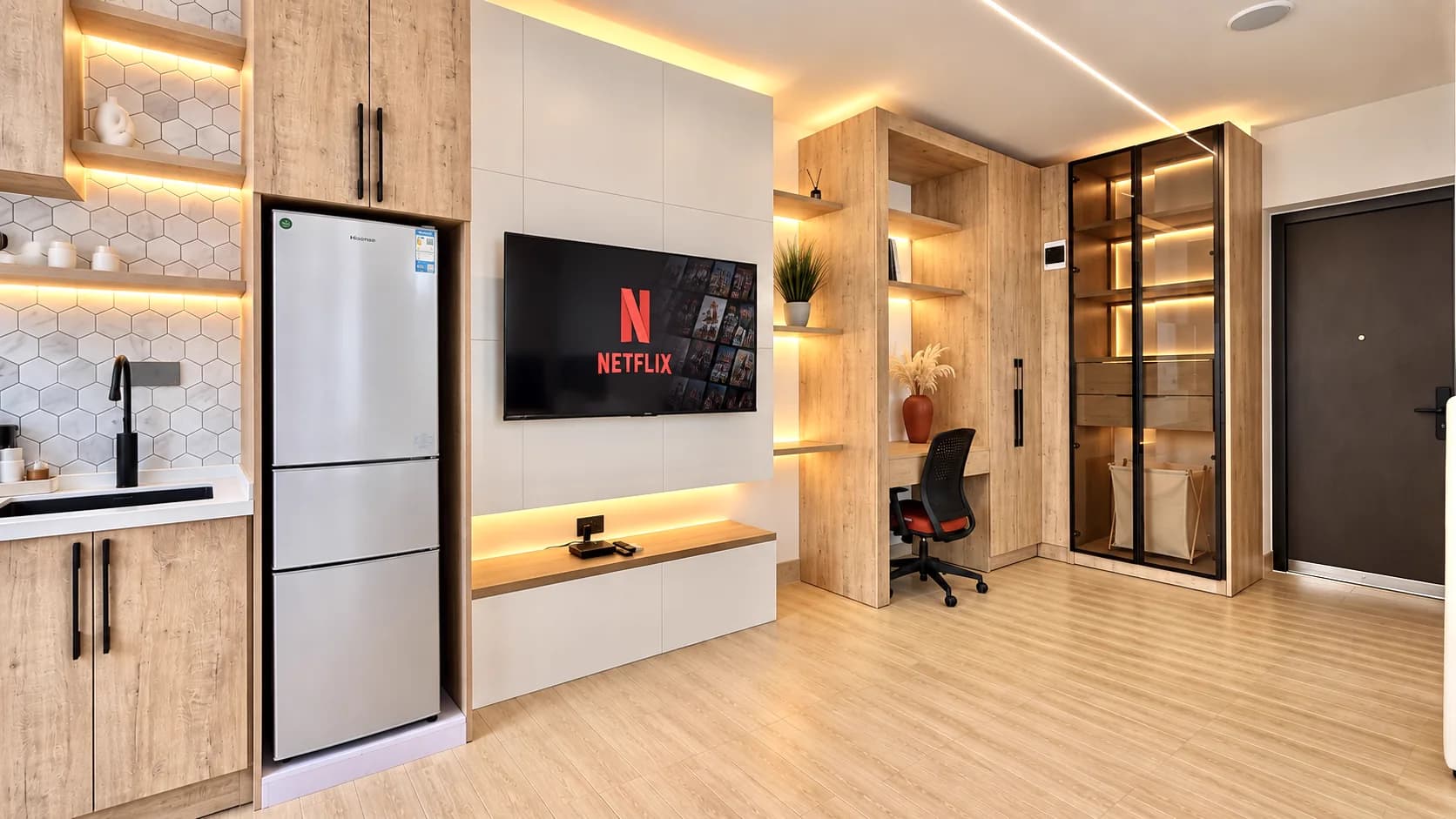
Connectivity. HMK Living runs fibre-optic mesh Wi-Fi throughout the building. The word doing the work there is mesh: multiple access points rather than one router near reception, so a video call holds as you walk from the desk to the kitchenette. Ask any property where its access points are. The answer is revealing.
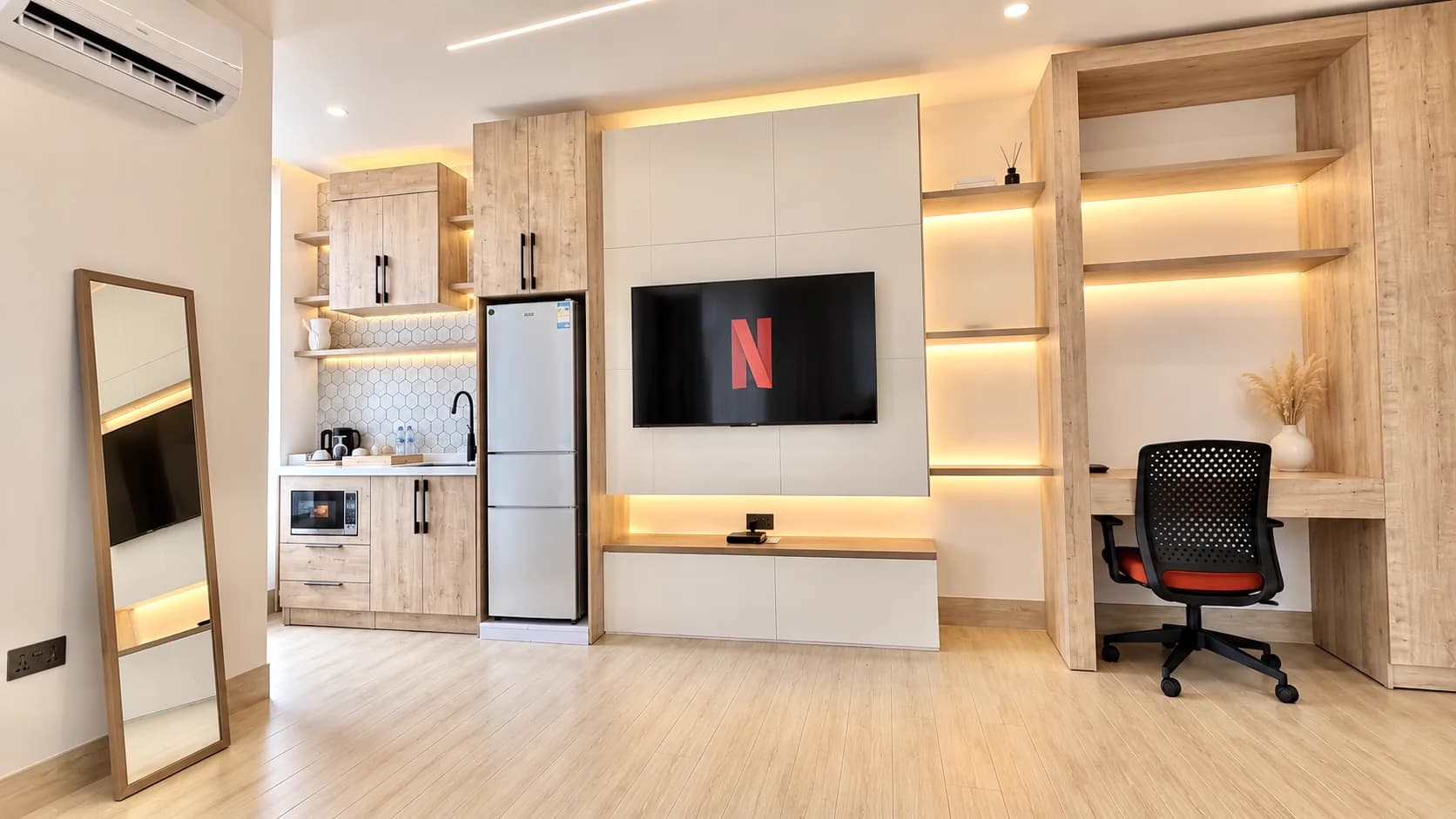
The desk. Every apartment has a work desk. On a two-hour call, the difference between a desk and a coffee table is the difference between finishing the day upright and finishing it with a sore neck.
The second screen. A 55-inch QLED television in every apartment doubles as a monitor for a deck or a spreadsheet. It is the cheapest productivity gain available in a hotel-shaped room and almost nobody uses it.
Separation. The 1BHK Suite, from 52 m² with one king, puts a door between the bedroom and the lounge. If you take calls at 10:00 PM or 6:00 AM, or you are sharing with a colleague on a different schedule, that door is the specification that matters.
The domestic layer. Daily housekeeping, laundry handled as a service, and breakfast included every morning. There are no washing machines in the apartments and none are needed — you hand laundry over and it comes back. On night nine of a two-week engagement, clean shirts contribute more to how the trip is going than anything in the brochure.
Two points of precision, because the market is loose with both words. A kitchenette is a kettle, a microwave and a fridge: the Studio Deluxe and the 1BHK Suite have one, and it is enough for coffee before an early call and a snack after a late finish. A fully stocked kitchen — the kind you cook a real meal in — is in the 2BHK Suite and the Penthouse only. Room service runs from the same ground-floor kitchen as the restaurant, so the à la carte menu reaches your desk either way.
Which apartment type matches which kind of trip?
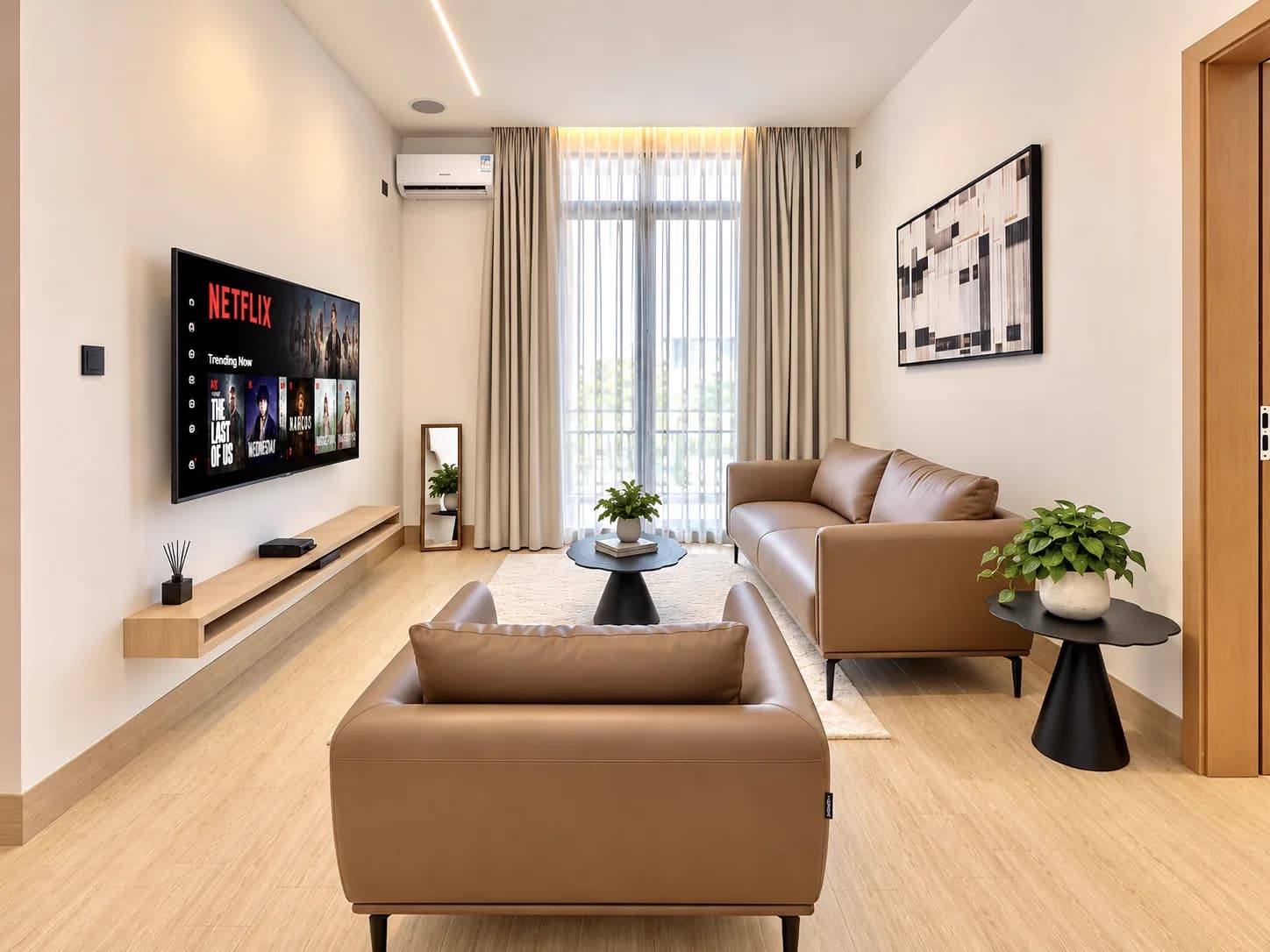
Match the apartment to the shape of the trip rather than to the seniority of the traveller. The four types differ on floor area, bed count and whether the kitchen is a kitchenette or a full one.
| Apartment | Size | Beds and baths | Kitchen | From | Fits |
|---|---|---|---|---|---|
| Studio Deluxe | From 32 m² | 1 queen, 1 bath | Kitchenette | $125 a night | Solo trips, two to four nights |
| 1BHK Suite | From 52 m² | 1 king, 1 bath | Kitchenette | $140 a night | Week-long stays, heavy call schedules |
| 2BHK Suite | From 88 m² | 2 kings, 2 baths | Fully stocked kitchen | $200 a night | Two colleagues, or family alongside |
| 3BHK Penthouse | From 180 m² | 3 kings, 3 baths | Fully stocked kitchen | $300 a night | Principals, small delegations, hosting |
A note on booking two colleagues into a 2BHK rather than two separate rooms: it is one reservation and one invoice line, with two king bedrooms, two bathrooms, a full kitchen and a shared lounge that doubles as a working space in the evening. For a project team on a two-week engagement, it is the configuration that changes the week most.
The full rate card sits on the pricing page, and facilities lists what is on site. For the longer-stay view, corporate housing in Kigo covers postings rather than trips.
What does a week look like from each base?
Here is the same itinerary — land Sunday, six meetings, three heavy desk days, fly out Friday — run from both bases, with the movements counted.
From a central Kampala hotel.
- Sunday. Land at Entebbe at 6:30 PM. Transfer into the city, exposed to whatever the evening road is doing. Dinner in the hotel.
- Monday. Breakfast downstairs. Three meetings, all short hops. A good day, and the reason people book central.
- Tuesday. Two meetings in the morning. Desk work in the afternoon, at a console table, with the window closed because of the noise.
- Wednesday. One meeting. Otherwise desk work, calls, and a growing awareness that the room is small and you have been in it for four days.
- Thursday. Desk work. Laundry becomes either a problem or an expensive per-item line.
- Friday. Airport run with a large buffer because the route is unpredictable, which means leaving earlier than the flight requires.
- Movements: two airport runs through or around the city, six short meeting hops.
From Kigo.
- Sunday. Land at Entebbe at 6:30 PM. The transfer is tracked against the flight number; 20 km of expressway later you are in the apartment. Room service rather than finding dinner.
- Monday. Breakfast in the ground-floor restaurant at 7:00 AM, included. Leave at 7:15 AM, before the inbound peak. Three meetings clustered in the city. Back by mid-afternoon, outside the outbound peak, then work from the desk until evening.
- Tuesday. Entirely remote. Mesh Wi-Fi, the desk, the television as a second screen, laundry handed over to housekeeping.
- Wednesday. Two meetings, one round trip, chauffeur arranged so both drives are working time. A working lunch hosted in the restaurant for the counterparty who was happy to come out.
- Thursday. Remote in the morning. An hour at the spa next door or nine holes at the championship course in the afternoon. A client dinner in Kololo in the evening, driving back after 7:00 PM when the road is clear.
- Friday. Breakfast, one last call, 20 km of expressway to Entebbe.
- Movements: two expressway airport runs, two city round trips, one meeting hosted on site.
Six meetings happened in both weeks. The Kigo version involved four city crossings instead of twelve and put both airport runs on a road that bypasses the city. That is the whole case, and it only holds if you cluster.

How do the costs compare once you count everything?
Compare the whole trip rather than the nightly rate, because the lines that differ are the ones outside the room rate. Four of them usually decide it.
Breakfast. Included with every stay at HMK Living, every morning. On a ten-night trip that is ten covers that never reach an expense claim.
Laundry. Handled as a service rather than priced per item in a bag on the wardrobe floor. Ask about the turnaround before you book; the concierge will confirm it.
The long-stay threshold. Stays of seven nights or more carry a discount of 10 to 20 per cent, applied across the stay rather than only to the nights past the seventh. A nine-night engagement crosses it; a fortnight crosses it comfortably. For a posting beyond that, ask for the extended-stay rate directly.
Transport. This is the line that goes up. A Kigo base costs more in ground transport than a Nakasero one, and pretending otherwise is not useful. What offsets it is the number of movements: clustered meetings mean fewer journeys, the expressway airport runs are predictable, and the activity tier you book on — Bronze, Silver, Gold or Platinum — determines the chauffeur hours included. The Penthouse is Platinum by default, which bundles chauffeur service with golf and spa access.
The honest summary: for one to three nights, central Kampala is usually cheaper all-in as well as more convenient. From about four nights, the included breakfast, the laundry service and the long-stay discount pull the other way, and by a two-week engagement it is not close.
What should you verify before you book either option?
Six checks, each answerable in one message, none of them visible in a photograph. They are the same checks whichever side of the city you land on.
- Is the Wi-Fi fibre, and is it mesh? Ask where the access points are. One router in reception is the commonest reason a stay fails as a workplace.
- Is there a real desk? Ask for a photograph of it. Console tables photograph like desks.
- Kitchenette or full kitchen? Decide what you need, then confirm what you are getting. This is the most frequent mismatch in the serviced-apartment market.
- Is the airport transfer booked against the flight number? In both directions, and with a named contact if the flight moves.
- What is the long-stay rate, in writing? Thresholds are usually at seven or fourteen nights, and discounts are rarely applied retrospectively.
- What does security look like at 2:00 AM? Armed security on site around the clock and a controlled entrance are not universal at this end of the market. At HMK Living both are standard, alongside a 24/7 guest concierge.
If you are travelling with sensitive material or at seniority, add a seventh: ask directly about privacy. A gated residential approach and staff who do not discuss guests are specifications, not atmosphere.
So which should you choose?
Read down this list and stop at the first line that describes your trip. The decision is usually settled by the second or third.
- One or two nights, meetings in the CBD. Central Kampala. Proximity wins and nothing else is close.
- Three nights, fixed early meetings every morning. Central Kampala, unless you can cluster, in which case either works.
- Four nights or more, mixed meetings and desk work. Kigo. This is the crossover point.
- Two or more airport runs in the trip. Kigo, on the expressway argument alone.
- Mostly remote work with a few meetings. Kigo, and book the 1BHK Suite for the door between the bedroom and the calls.
- Two colleagues travelling together. Kigo, in a 2BHK Suite — one booking, two kings, two baths, a full kitchen.
- A posting of a month or more. Kigo, on the extended-stay rate. See corporate housing in Kigo.
- A principal with staff, or hosting during the trip. The 3BHK Penthouse, on Platinum tier.
- You cannot control your own schedule. Central Kampala. The Kigo pattern depends on clustering, and clustering depends on control.
The rule underneath all of it: short and meeting-dense means central; long, remote-heavy or airport-frequent means Kigo. The middle ground is a judgement about what you want your evenings to be.
How do you book, and what should you settle at the same time?
Book direct and settle four things in one conversation: the apartment type, the airport transfers in both directions, the activity tier and the long-stay rate. Doing them together saves a round of emails and avoids the two commonest surprises.
Check dates and reserve, or message the WhatsApp concierge on +256 748 390 401; the office line is +256 393 101 080. Payment is settled on arrival, and website bookings carry free cancellation up to 48 hours before check-in, which matters on an itinerary that is still moving.
Worth raising in the same message: the activity tier, since Bronze, Silver, Gold and Platinum determine chauffeur hours, golf privileges and spa access; whether a working breakfast or lunch can be set up in the restaurant for a counterparty; what the surrounding area offers for a free afternoon; and whether your trip includes any hosting, which the events page covers. For a block of apartments for a visiting team, ask for it as one quote rather than booking individually.
Plan the trip
For the wider market view, read corporate accommodation in Kampala for executives. For the neighbourhood comparison in detail, Kigo versus Nakasero. For the arrival itself, the Entebbe Airport to Kigo guide covers the drive and what to expect at the terminal.
Then see hotel accommodation in Kigo for the property in full, the pricing page for the rate card, and reservations to hold the dates.
Reserve your stay at HMK Living, Kigo.
A curated boutique apartment. Direct rates, real-time availability, and an agentic WhatsApp concierge that handles the rest.
Planning a trip? Read our guide to hotel accommodation in Kigo.
The HMK Living editorial team — covering hospitality, travel, and life around Kampala's lakeside. Articles are reviewed by the founding team for accuracy on local detail.
Common questions about this topic.
It depends on how many of your commitments are fixed inside the city and how many times your trip touches the airport. If you have morning meetings in Nakasero on three consecutive days, stay central. If you fly in and out within the same week, or run most of your day from a laptop, Kigo is the better base — it sits about 20 km from Entebbe International Airport via the Entebbe Express Highway and roughly 25 minutes from central Kampala.