Extended Stay & Monthly Rates in Kigo: What to Know Before You Book
A practical guide to monthly accommodation in Kampala and long stays in Kigo — how the seven-night threshold works, which apartment suits a month, what the rate does and does not include, and the questions to settle before you commit.

A month is not a holiday with extra nights attached. Once a stay runs past a week, the things that decide whether it works stop being the view and the welcome and start being the internet, the kitchen, the laundry, the commute and the rate.
This is the guide to getting all five right in Kigo — what changes at seven nights, which apartment survives a month, what the rate covers, how a serviced apartment compares with renting a flat in Kampala, and the questions to settle before you commit to anything longer than a fortnight.
What counts as an extended stay in Kigo?
Seven nights is where the commercial terms change, and roughly a month is where the booking becomes a different conversation. Below seven nights you are buying nights; at seven and above you are buying a stay, with a discount of 10 to 20 per cent applied across the whole booking.
Past about four weeks, the arrangement moves to what HMK Living calls the Extended Retreat, quoted on request rather than published. That is not evasiveness — a two-month booking in a Studio Deluxe in a quiet season and a six-week booking in a 2BHK Suite over a busy one are genuinely different numbers, and a single published figure would be wrong for both.
The three shapes of long stay that turn up most often in Kigo:
- The contract stay. Four to twelve weeks, built around a project, an audit, a construction supervision role or a consulting engagement. Usually one person, sometimes two colleagues sharing.
- The relocation bridge. Six to ten weeks while a house is found, a lease is signed and a container clears. Often a family, and often with a vehicle and a school run attached.
- The season. A month or two of deliberate base-building — remote work, a long visit home, a stretch of golf and recovery, or a researcher's run at a project.
Each one wants a different apartment and a different set of questions, which is most of what follows.
How does the seven-night discount actually work?
It applies to the whole stay, not only to the nights past the seventh. Book seven nights or more and the 10 to 20 per cent comes off the full booking, which is why booking a week as one reservation rather than as several short ones matters.
The exact percentage inside that band depends on the apartment type, the season and the length of the stay. A fortnight sits further into the band than eight nights; a month sits further still, and past a month the Extended Retreat quote replaces the band altogether.
Two practical consequences are worth planning around.
Do not split the booking. Seven separate one-night reservations, or a five-night booking plus a three-night booking, will not read as a single long stay. If a trip is probably going to run eight nights, book eight nights and shorten it later rather than booking five and extending twice.
Ask before the booking is raised. Long-stay rates are agreed in advance, not applied retrospectively once a guest realises they have been there a fortnight. One message to the WhatsApp concierge on +256 748 390 401, or the office line on +256 393 101 080, settles it before anything is confirmed.
The published rate card sits on the pricing page, and the long-stay terms are set out on the extended-stay page. The band in the middle is a conversation.
Which apartment should you choose for a month or more?
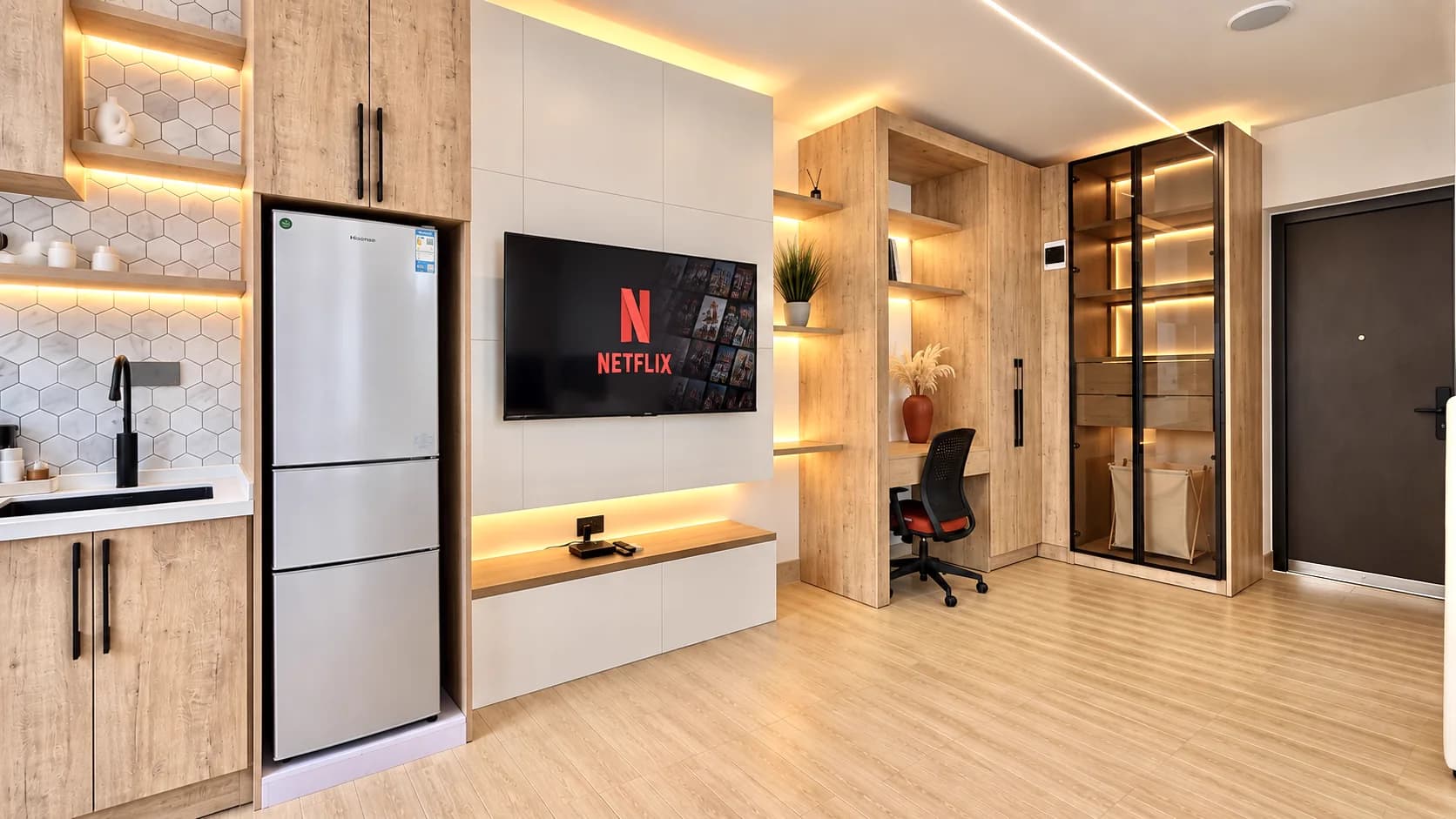
Choose by kitchen and by how many rooms you need to be able to close a door on — not by floor area. Over a month those two variables account for almost all of the difference between an apartment that works and one that slowly wears you down.
| Apartment | Size | Beds and baths | Kitchen | From | Long-stay verdict |
|---|---|---|---|---|---|
| Studio Deluxe | From 32 m² | 1 queen, 1 bath | Kitchenette | $125 a night | Workable solo for two to four weeks if you eat downstairs |
| 1BHK Suite | From 52 m² | 1 king, 1 bath | Kitchenette | $140 a night | The default for a solo contract stay of a month or more |
| 2BHK Suite | From 88 m² | 2 kings, 2 baths | Fully stocked | $200 a night | The long-stay choice for two colleagues or a family |
| 3BHK Penthouse | From 180 m² | 3 kings, 3 baths | Fully stocked | $300 a night | A principal with staff, a larger family, or hosting |
The honest reading of that table for a long stay is as follows.
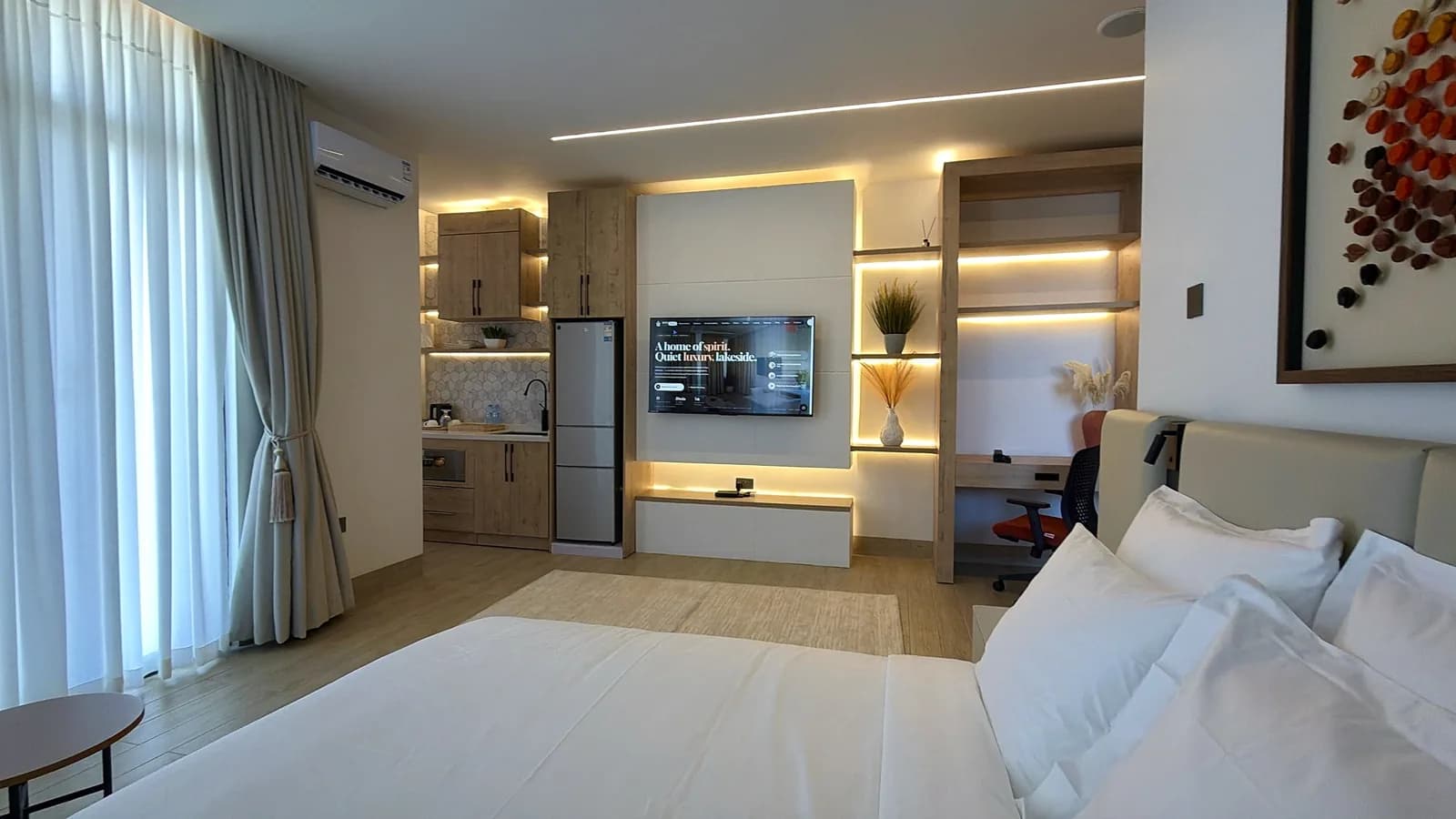
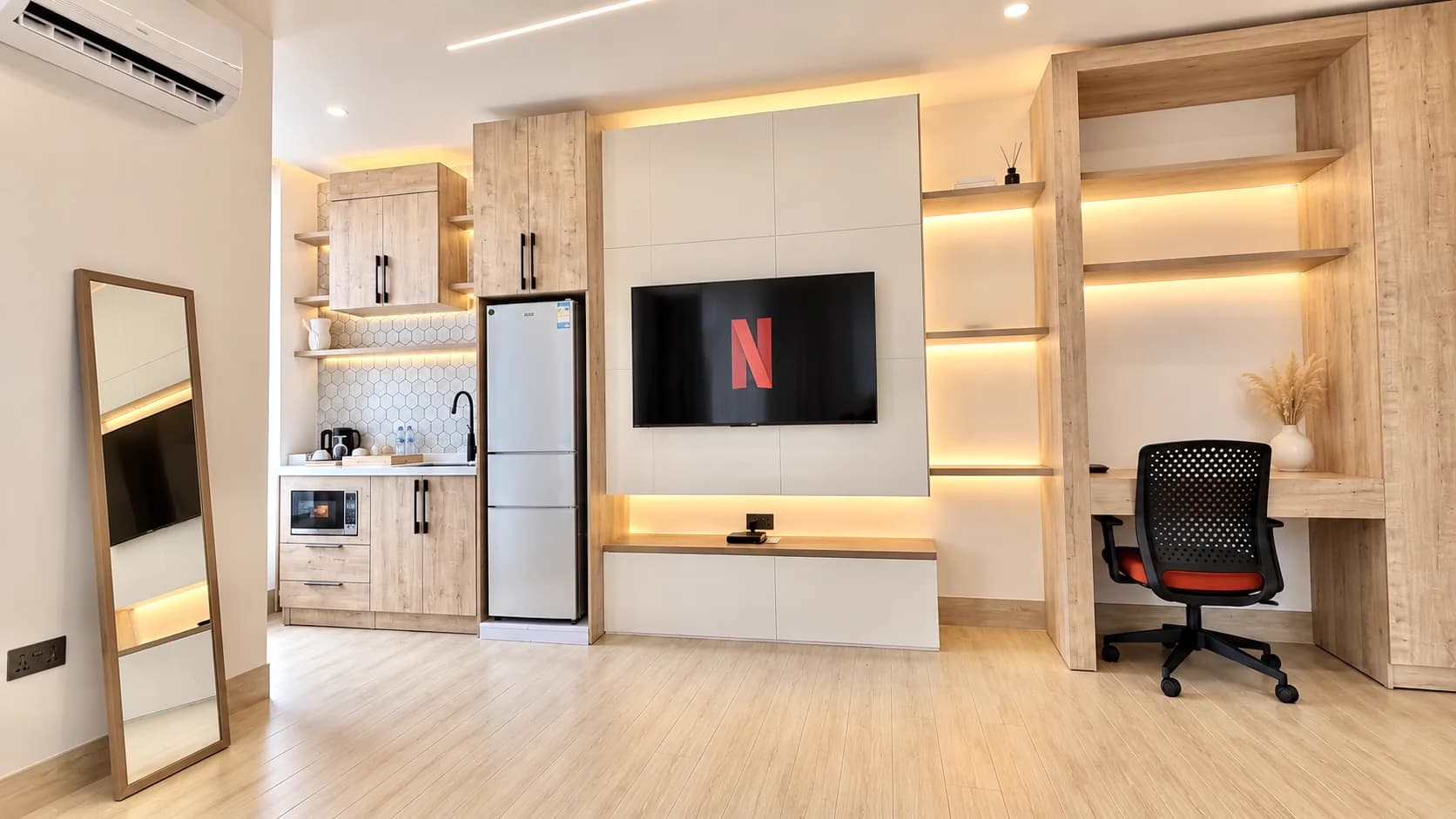
A Studio Deluxe is a good solo apartment and a disciplined one. From 32 m² with a queen bed, a work desk and a kitchenette, it suits someone who genuinely eats breakfast downstairs, lunches out and takes dinner from the à la carte menu or room service. Where it strains is the single-room layout: on a long stay, sleeping and working in the same room is the thing people tire of first.
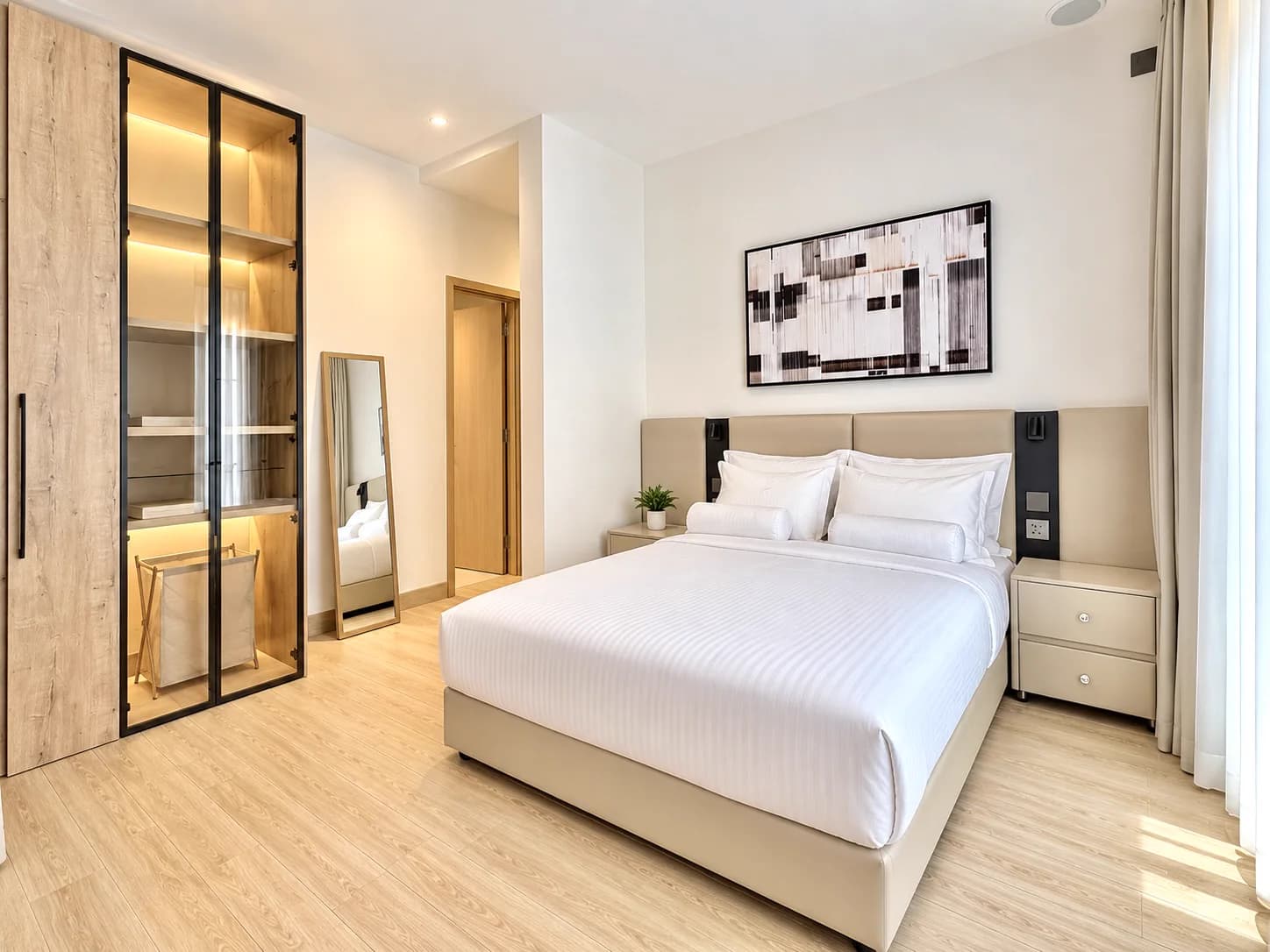
A 1BHK Suite is the apartment most solo long stays end up in, and the reason is the door. From 52 m² with a king bed and a separate sitting room, it lets the working day end in a different room from the one you sleep in — which sounds like a small thing in week one and a large one in week five. The kitchen is still a kitchenette.
A 2BHK Suite is where a long stay stops being accommodation and starts being somewhere you live. From 88 m² with two king bedrooms, two bathrooms and a fully stocked kitchen, it books as one apartment rather than two rooms, which is why two colleagues on a ten-week engagement usually land here, and why relocating families do too.
A 3BHK Penthouse is 180 m² on the top floor with three kings and three bathrooms, a fully stocked kitchen and Platinum activity tier by default — chauffeur, golf and spa. For a principal travelling with staff, a larger family bridging a relocation, or anyone who will be hosting during the stay, it is the format that absorbs all three jobs at once.
Does the kitchen question really matter over a month?
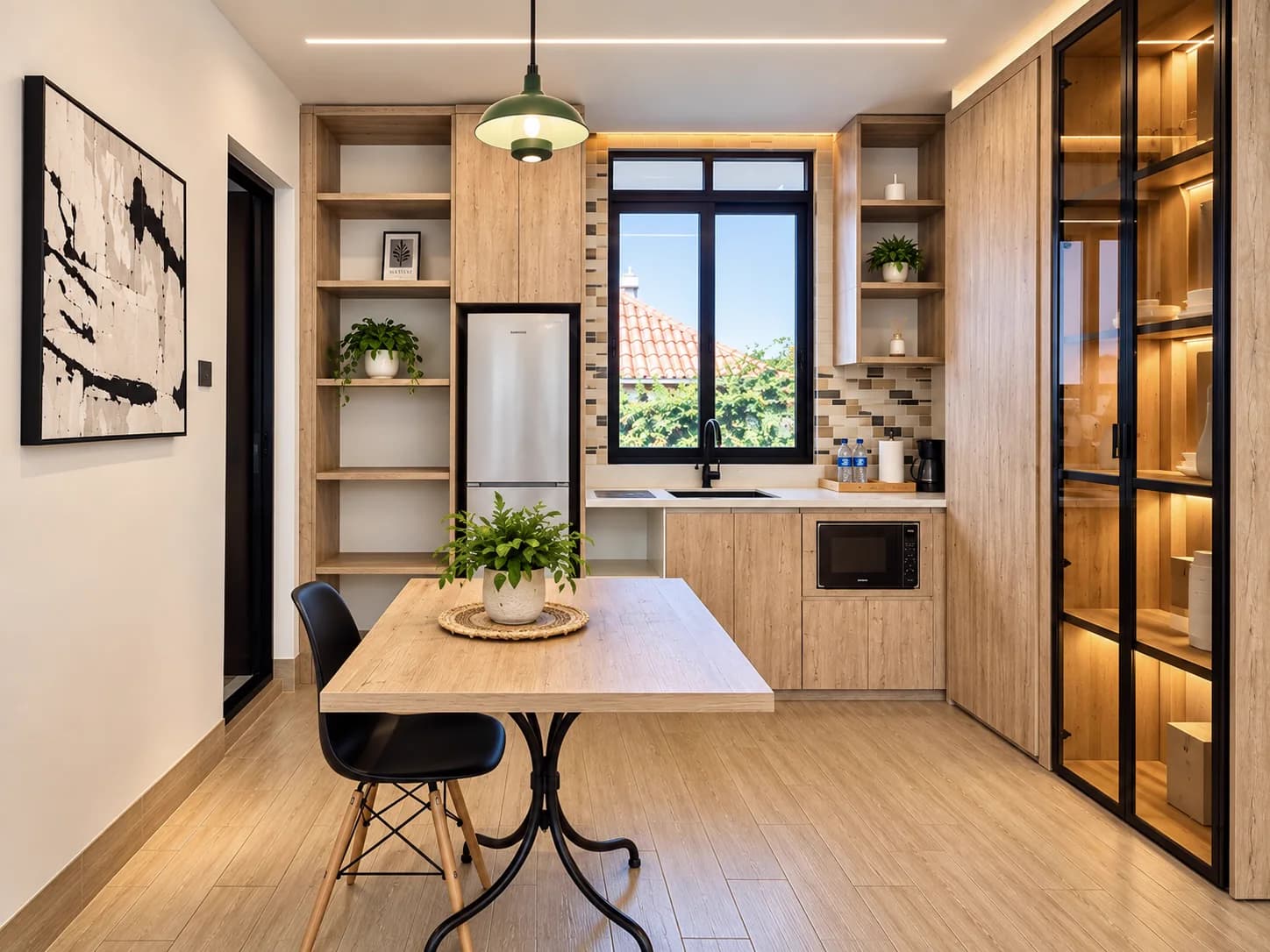
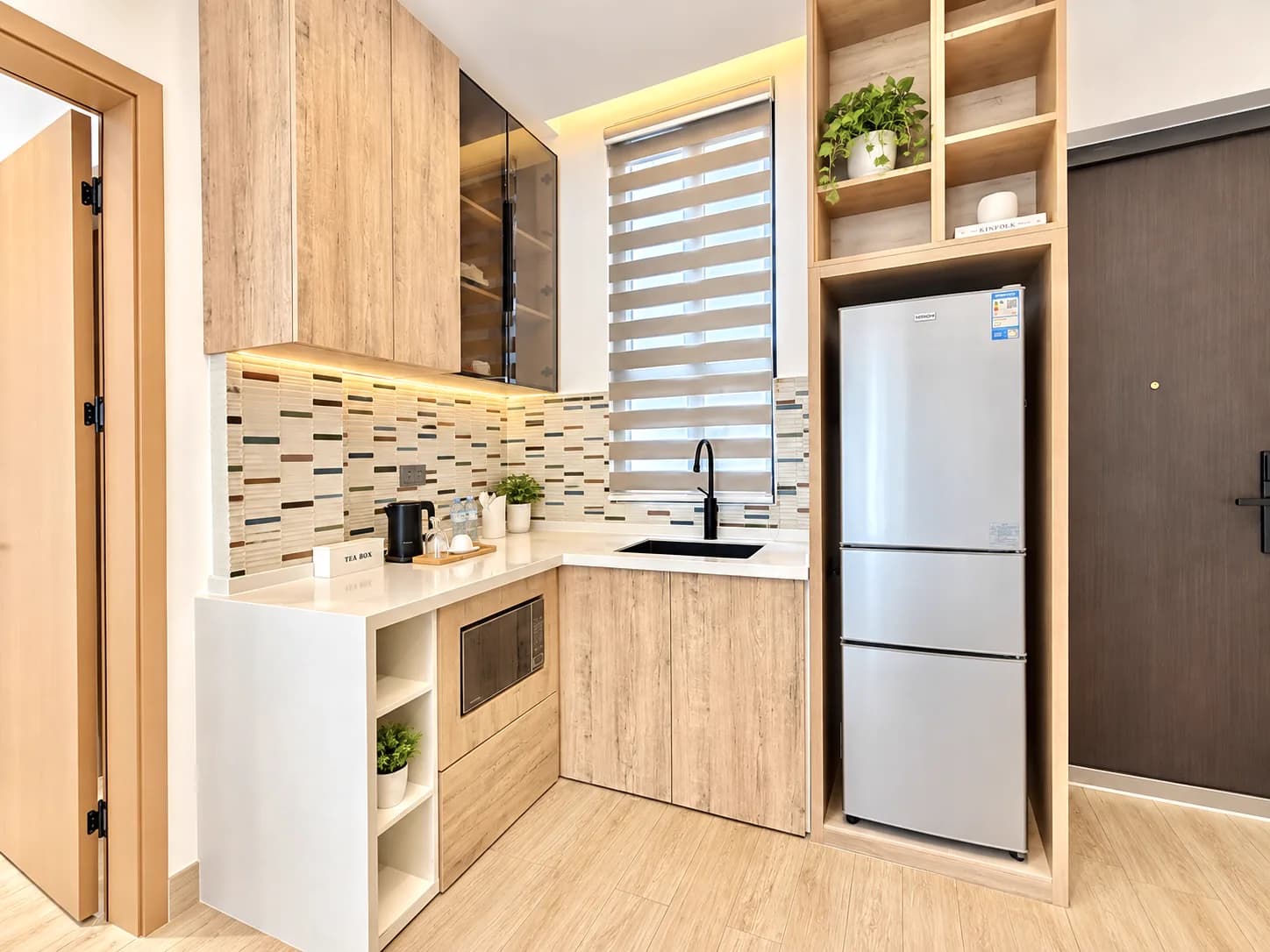
Yes, more than any other single specification. Only the 2BHK Suite and the 3BHK Penthouse have fully stocked kitchens; the Studio Deluxe and the 1BHK Suite have a kitchenette with a kettle, a microwave and a fridge.
That distinction is the most common mismatch in the serviced-apartment market anywhere, and a month is long enough for it to matter. A kitchenette covers coffee at six in the morning, a cold drink at the end of the day, breakfast outside restaurant hours and anything that can be heated. It does not cover cooking a meal from raw ingredients for three people on a Tuesday.
Whether that is a constraint depends on what you want your evenings to be. Breakfast is included with every stay and served in the ground-floor restaurant; lunch and dinner are à la carte from the same kitchen — grills, curries, pizza, pasta, salads, coffee and fresh juice — and room service will bring any dish up to the apartment. A solo contract stay can run for a month on that pattern without ever needing a hob.
Most people on a long stay still want to cook sometimes, and not for the money. Cooking two or three nights a week is what makes six weeks in one place feel like living somewhere rather than staying somewhere, and it is the single best argument for taking the 2BHK Suite over the 1BHK when the length crosses a month.
What does the rate cover, and what sits outside it?
The rate covers the daily running of your life in the building; it does not cover transport, meals beyond breakfast, or anything arranged off site. Knowing which side of that line each item falls on is what makes an extended-stay budget hold.
Inside the rate, every night of the stay:
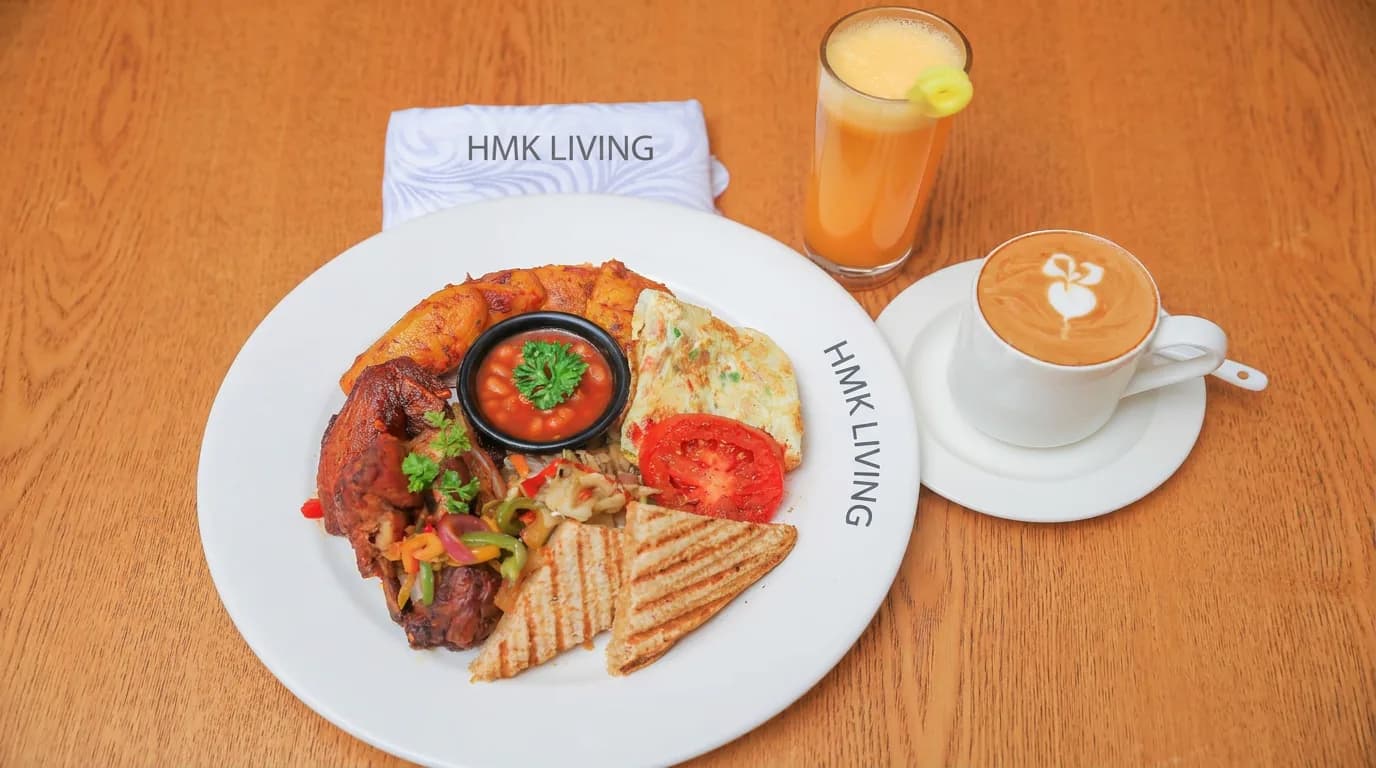
- Breakfast in the ground-floor restaurant, every morning
- Daily housekeeping
- Laundry as a service, with no washing machines in the apartments
- Fibre-optic mesh Wi-Fi throughout the building
- A work desk in every apartment, and a 55-inch QLED television
- Premium linen
- 24/7 armed security on site and a 24/7 guest concierge
Outside the rate, and worth pricing before you arrive:
- Lunch and dinner, à la carte from the restaurant kitchen, plus room service
- Airport transfers and chauffeur hours beyond what your activity tier includes
- Golf at the championship resort next door and treatments at the wellness spa, again subject to tier
- Anything the concierge arranges off site — cruises, charters, excursions, a hired vehicle
The activity tier is the part long-stay guests most often leave unsettled, and it should be agreed with the rate rather than after it. Bronze, Silver, Gold and Platinum differ in spa access, golf privileges and chauffeur hours, and the Penthouse carries Platinum by default. Over a month, a tier that includes chauffeur hours can change the transport budget more than the apartment choice changes the accommodation one.
How does an extended stay compare with renting a flat in Kampala?
On the nightly figure a serviced apartment looks more expensive; on the total cost of a two- or three-month stay it frequently is not. Rental in Kampala carries a long tail of costs and obligations that a serviced apartment folds into one number.
What a rented flat usually asks for before you have slept in it:
- Rent in advance. Several months at once is normal in Kampala, and six or twelve is not unusual at the upper end of the market.
- A deposit, plus an agent's commission.
- Furniture. Most unfurnished lets mean unfurnished — beds, a sofa, a table, a fridge, kitchen equipment, linen, curtains.
- Utilities and internet. Accounts to open, a connection to install, and a wait for an engineer.
- Staff or services. Someone to clean, someone to handle laundry, and somebody to be there when nobody is.
- An exit. Notice periods, dilapidations, and a flat full of furniture to dispose of when the assignment ends.
A serviced apartment answers all six with one rate and a check-in time. Nothing is bought, nothing is installed, nothing is disposed of, and the stay can be extended or ended on terms agreed in advance rather than in a lease signed on arrival.
Where renting genuinely wins is duration and autonomy. Past about six months, a lease is usually cheaper, and a family who wants a garden, a particular school catchment and their own furniture is not really in the market for a serviced apartment at all.
The clean rule of thumb: up to about three months, take the serviced apartment; past six months, take the lease; between the two, run the numbers properly and weigh how certain the end date is. The comparison with the short-let market is written out in full in HMK Living against Airbnb in Kigo, and the corporate-booker version of the same decision in corporate accommodation in Kampala.
What does a month in Kigo actually feel like week by week?
It settles into a rhythm faster than a hotel stay does, usually by the end of the first week. The reason is that the repeated decisions — breakfast, laundry, cleaning, security, internet — are all answered by the building rather than by you.
Week one. Arrival, the apartment, and working out the geography. Kigo Road in Wakiso District, the Lake Victoria championship golf resort and the wellness spa next door, Munyonyo about ten minutes up the road, central Kampala roughly 25 minutes, and Entebbe International Airport about 20 km away on the Entebbe Express Highway. Hand the laundry over on the first full day and the week stops being about logistics.
Week two. The working pattern arrives. Breakfast downstairs, the desk until mid-afternoon, calls that hold on fibre mesh Wi-Fi, and two or three runs into the city for the meetings that have to happen in person. The area guide covers the practical geography — supermarkets, pharmacies, fuel and the routes in.
Week three. The point at which the apartment choice justifies itself or does not. A separate sitting room, enough wardrobe space for a month of clothes, and a kitchen if you took one are the three things that decide it.
Week four. Either the end, or the extension conversation. If it is the latter, ask early: the concierge can usually keep you in the same apartment if there is notice, and cannot always do so on the last night.
The one thing to plan deliberately is the weekend. A month of weekdays in the same building needs punctuating, and Kigo is well placed for it — a round at the resort next door, a treatment at the spa, an afternoon on the lake, or a drive to Entebbe for the Botanical Gardens. The options are set out in things to do near Kigo.
What should you ask before booking an extended stay?
Ask eight questions, all of which can be answered in one message. None of them is visible in a photograph, and every one of them is cheaper to resolve before the booking than after it.
- What is the long-stay rate for my exact dates, in writing? Not the band, the figure. Seasons move it.
- Kitchenette or fully stocked kitchen? Confirm which apartment type you are being quoted, by name.
- How does laundry work over a month? Volume, turnaround and what is excluded.
- What does daily housekeeping include, and what does it not?
- Is the Wi-Fi fibre, and is it mesh across the building? One router in reception behaves differently from mesh coverage, and you will discover which on your first long call.
- Which activity tier applies, and what does it include? Spa access, golf privileges and chauffeur hours, agreed alongside the rate.
- What are the transport arrangements? Airport transfers against a flight number, and what a weekday run into Kampala looks like.
- What are the payment and cancellation terms? Payment is settled on arrival, and website bookings carry free cancellation up to 48 hours before check-in; for a long stay, agree the billing rhythm as well.
Add a ninth if a family is coming: say so explicitly and ask the concierge what can be arranged, rather than assuming. Anything beyond the apartment itself is something to agree in advance.
Who is a long stay in Kigo wrong for?
It is wrong for anyone with daily meetings in central Kampala, and wrong for anyone who wants to walk out of the door into a city. Both are real constraints, and neither is solved by a good apartment.
If briefings are in Nakasero five mornings a week, roughly 25 minutes each way will accumulate into something you resent by the third week; a city-centre base is the better answer, and the neighbourhood case is argued properly in Kigo versus Nakasero. Kigo is residential and quiet, which means no café three doors down and no bar around the corner — the restaurant downstairs, the resort next door, Munyonyo ten minutes away and the city at 25 minutes are the options.
There is also no swimming pool at HMK Living, and no washing machine in the apartment. Guests who want water time use the managed facilities at the resort next door or get out onto the lake; laundry is a service rather than a machine. Both are worth knowing before a month rather than after a week.
For everyone else — contract staff, relocating executives, remote workers, families bridging a move, anyone who flies more often than they commute — the balance between a 20 km airport run and a 25-minute city run is exactly the point of staying here.
How do you book a monthly stay, and what are the terms?
Book direct, and get the quote before the reservation. Website bookings carry free cancellation up to 48 hours before check-in and payment is settled on arrival, and for anything past seven nights the rate is agreed with the concierge rather than taken off a page.
The sequence that works:
- Check what is available for your dates on the reservations page.
- Read the long-stay terms on the extended-stay page and the published rates on the pricing page.
- Message the WhatsApp concierge on +256 748 390 401, or call the office line on +256 393 101 080, with your dates, the apartment type and the number of people.
- Settle the activity tier at the same time as the rate.
- Confirm transport, laundry terms and the billing rhythm in the same thread, so the whole arrangement sits in one place.
For the wider picture of what is on site, the facilities page lists it, and the pillar guide to hotel accommodation in Kigo sets the property in the context of the area.
The bottom line
A long stay is bought on five things: the rate band, the kitchen, the laundry, the internet and the commute. Get those right and the rest of a month in Kigo takes care of itself, because the building is doing the repetitive work.
Book seven nights or more as one reservation to take the 10 to 20 per cent. Take the 1BHK Suite if you are alone and the 2BHK Suite if you are two or want to cook. Ask for the Extended Retreat quote past a month, settle the activity tier with the rate, and tell the concierge early if the assignment is likely to run longer than the booking.
Start with the extended-stay page, check your dates on the reservations page, and read work from Kampala if the stay is a remote-working one. Questions go to the WhatsApp concierge on +256 748 390 401 or the office line on +256 393 101 080.
Reserve your stay at HMK Living, Kigo.
A curated boutique apartment. Direct rates, real-time availability, and an agentic WhatsApp concierge that handles the rest.
Planning a trip? Read our guide to hotel accommodation in Kigo.
The HMK Living editorial team — covering hospitality, travel, and life around Kampala's lakeside. Articles are reviewed by the founding team for accuracy on local detail.
Common questions about this topic.
At HMK Living the commercial terms change at seven nights. Stays of seven nights or more carry a discount of 10 to 20 per cent, applied across the whole stay rather than only the nights beyond the threshold. Past roughly a month the booking moves to the Extended Retreat arrangement, which is quoted on request through the concierge because it depends on the apartment type, the season and the length of the commitment.