Work From Kampala: The Rise of Luxury Remote Work Retreats in Uganda
Kampala has quietly become a workable base for remote executives — fibre-optic mesh Wi-Fi, a desk in every apartment, 20 km to Entebbe International Airport, and a lakeside setting built for the work-from-sanctuary professional. The practical guide.

The work-from-anywhere generation of executives — founders, consultants, senior people at distributed companies — has spent five years cycling through Lisbon, Dubai, Cape Town and Bali. Kampala has not been on that list, and for most of those years it should not have been.
That has changed, and the reasons are specific rather than atmospheric: fibre-optic internet across the better properties since 2022, the Entebbe Express Highway cutting the airport run, and a generation of serviced apartments built on the assumption that a guest might work a full week from the desk rather than sleep between meetings. This guide sets out the case, the caveats, and how to test it on a first trip.
Why is Kampala suddenly workable for remote executives?
Four things make the case: a time zone that overlaps almost everyone, English as the working language, cost and quality of life that compare well with any European base, and — finally — the infrastructure to support a working week. The first three have been true for a long time; only the fourth is new.
The honest framing is that Kampala was never a connectivity problem at the country level. It was a workspace problem at the property level.
Time-zone leverage. UTC+3 with no daylight saving is one of the most useful positions on the map for anyone working with Europe, the Gulf or India. The working day lines up without anybody getting up early.
English-first. Uganda's working language is English across banking, professional services, hospitality and transport. No translation layer, no misunderstood invoice, no awkwardness arranging a driver.
Cost and quality of life. A senior remote worker can take a serviced apartment, eat well every day, have a chauffeur on hand and spend weekends on a championship golf course for a fraction of what the equivalent week costs in London or Singapore.
The infrastructure layer. The Entebbe Express Highway, the fibre rollout, and the arrival of properties with a desk in every apartment rather than a business centre on the ground floor.
How does the Kampala time zone work for international calls?
Kampala is UTC+3, and because Uganda does not observe daylight saving the arithmetic stays constant all year — which is more valuable than it sounds if you run a recurring meeting. The table below is the practical version.
| Your counterpart | Their time when it is 15:00 in Kampala | Usable window from Kigo |
|---|---|---|
| London (UTC+1 summer) | 13:00 | 10:00 – 20:00 |
| Berlin, Paris | 14:00 | 10:00 – 20:00 |
| Dubai | 16:00 | 09:00 – 21:00 |
| Mumbai | 17:30 | 08:00 – 20:00 |
| New York | 08:00 | 15:00 – 23:00 |
| San Francisco | 05:00 | 18:00 – 21:00 |
Read that table as a shape rather than a schedule. Mornings in Kigo are quiet — nobody in Europe is at their desk yet — which makes them the best deep-work block you will get anywhere, and the calls stack naturally into the afternoon and early evening.
The one genuine limitation is the US West Coast. If your week is built around San Francisco, Kampala gives you a single evening window and nothing else, and you should know that before booking a month.
What does a working week in Kigo actually look like?
Here is a template week that uses the time zone rather than fighting it. It is the rhythm most executives settle into within three or four days.
- 06:30 — coffee on the balcony. The lake side of the building is quiet at this hour.
- 07:00 – 11:30 — the deep-work block. Europe is not awake yet, so nothing interrupts. This is the single strongest argument for working from East Africa.
- 11:30 – 13:00 — breakfast downstairs, or a walk on the lakeside before the heat.
- 13:00 – 18:00 — calls. Europe's afternoon, then the Gulf, then New York's morning, all inside one block.
- 18:00 – 19:30 — the spa next door, or the golf course for nine holes before the light goes.
- 19:30 — dinner from the à la carte menu downstairs, or sent up to the apartment.
- Weekends — eighteen holes on the championship course adjacent to the property, or the lake, or 25 minutes into central Kampala.
The pattern that emerges is consistent: focused mornings, calls through the afternoon, and evenings that are genuinely finished. The geography supports it — golf next door, a spa next door, the lake at the end of the road and the airport 20 km away when you need to leave.
What should you check before booking a remote-work stay anywhere in Kampala?
Interrogate the connectivity and the desk, in that order, and do not accept "we have Wi-Fi" as an answer. The gap between properties in Kampala is much wider than the gap between cities.
Ask these six questions of any property before you pay:
- Is the building on fibre, or on a mobile network? Fibre to the building is the only answer that supports video calls through the working day. HMK Living runs fibre-optic mesh Wi-Fi throughout the building.
- Is it mesh, or one router? A single access point in a lobby means dropouts upstairs. Mesh coverage per floor is what you want, and it is what "mesh Wi-Fi" means when a property says it.
- What happens in a power cut? Uganda's grid is far better than it was, but ask directly what backup the building has and whether the Wi-Fi stays up with it.
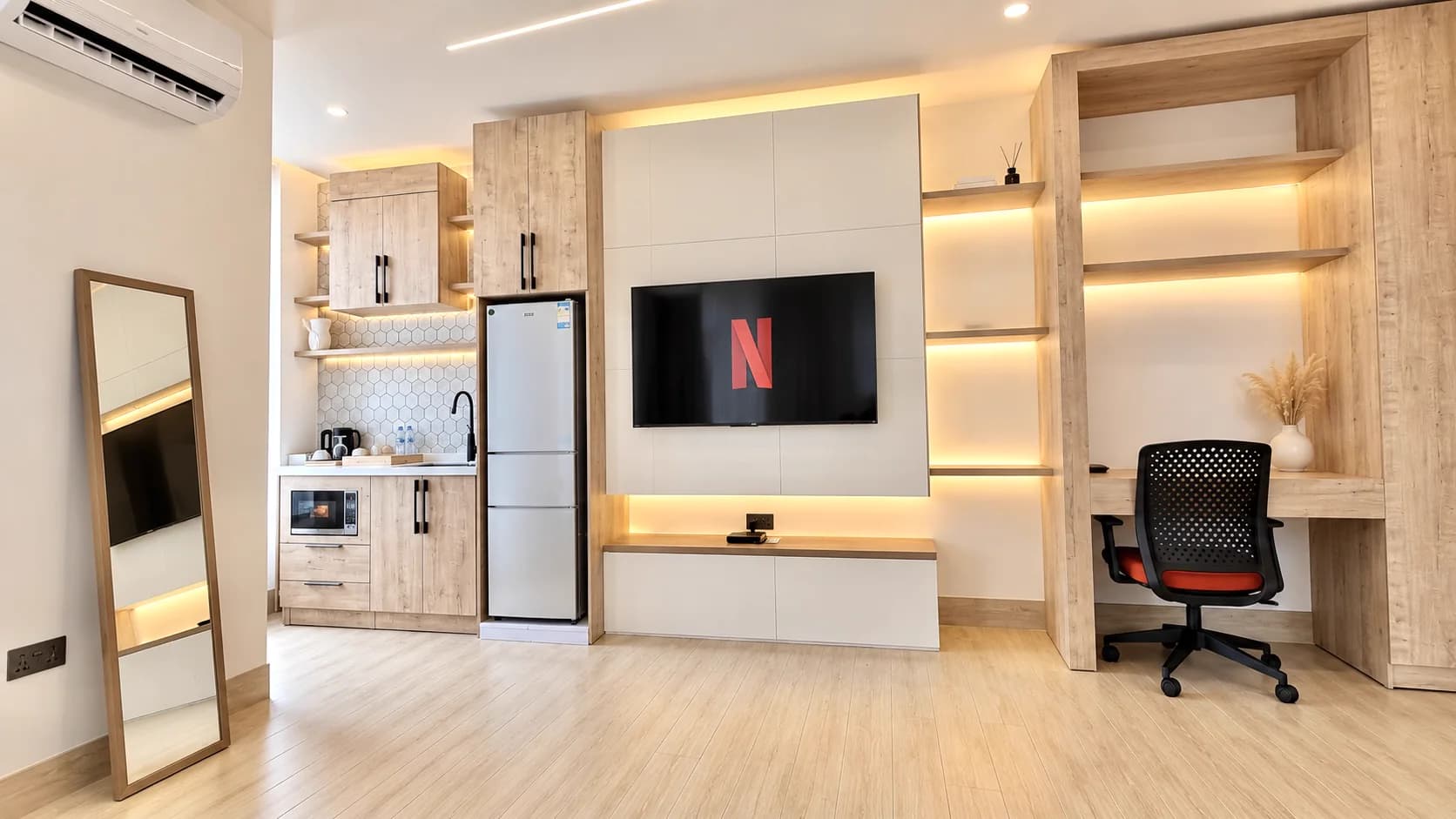
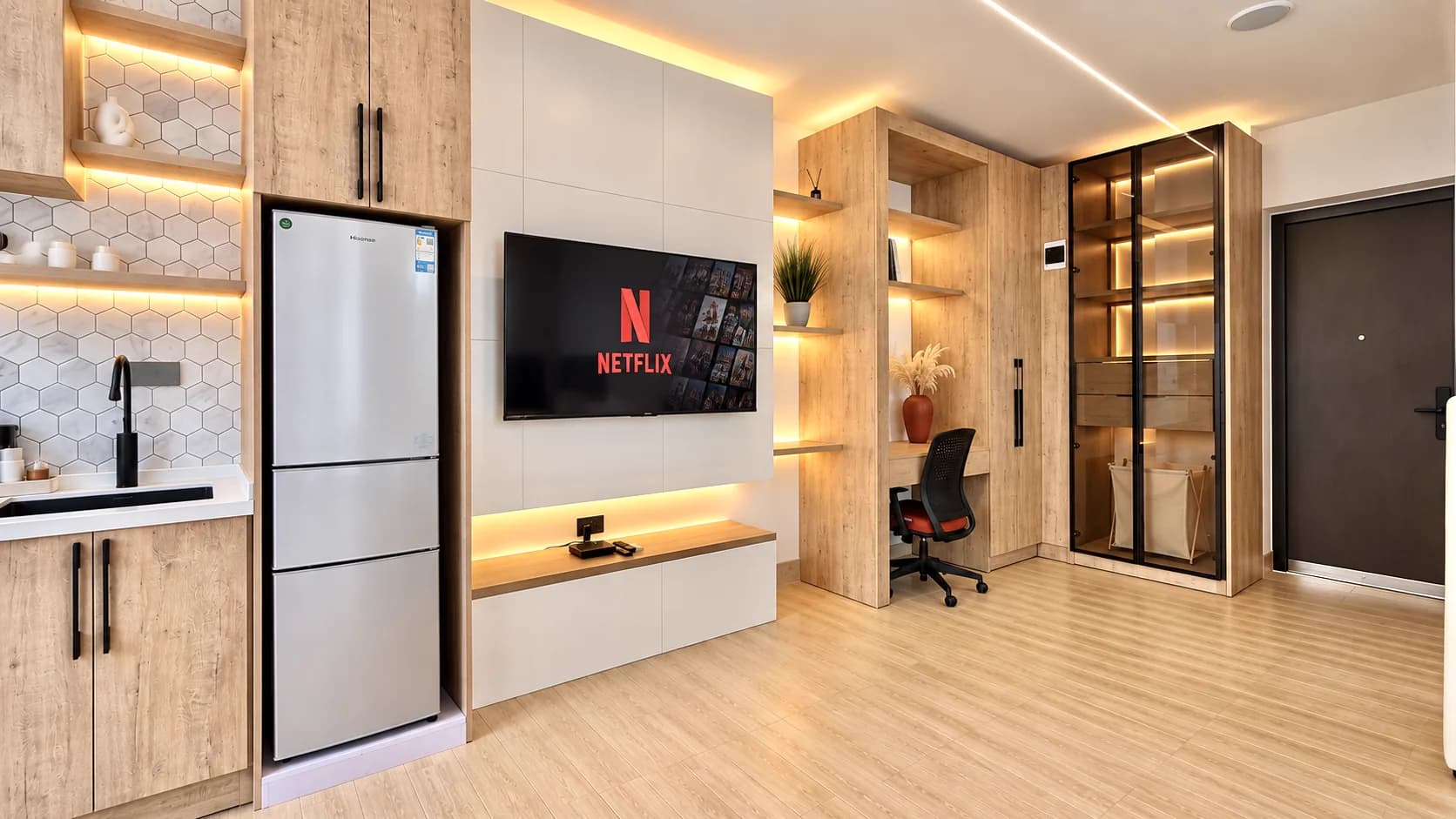
- Is there a desk, and what is the chair? A desk with a dining chair is not a workspace for a four-hour block. Ask for a photograph of the actual desk in the actual apartment.
- Where does the light fall during your call hours? Backlighting from a window ruins video calls. Ask which way the desk faces.
- Can you take a 10pm call without waking somebody? This is a layout question, and it is the one that decides between a studio and a one-bedroom.
The first five are property questions. The sixth is a typology question, and it is the one most people get wrong.
Which apartment should a remote worker book?
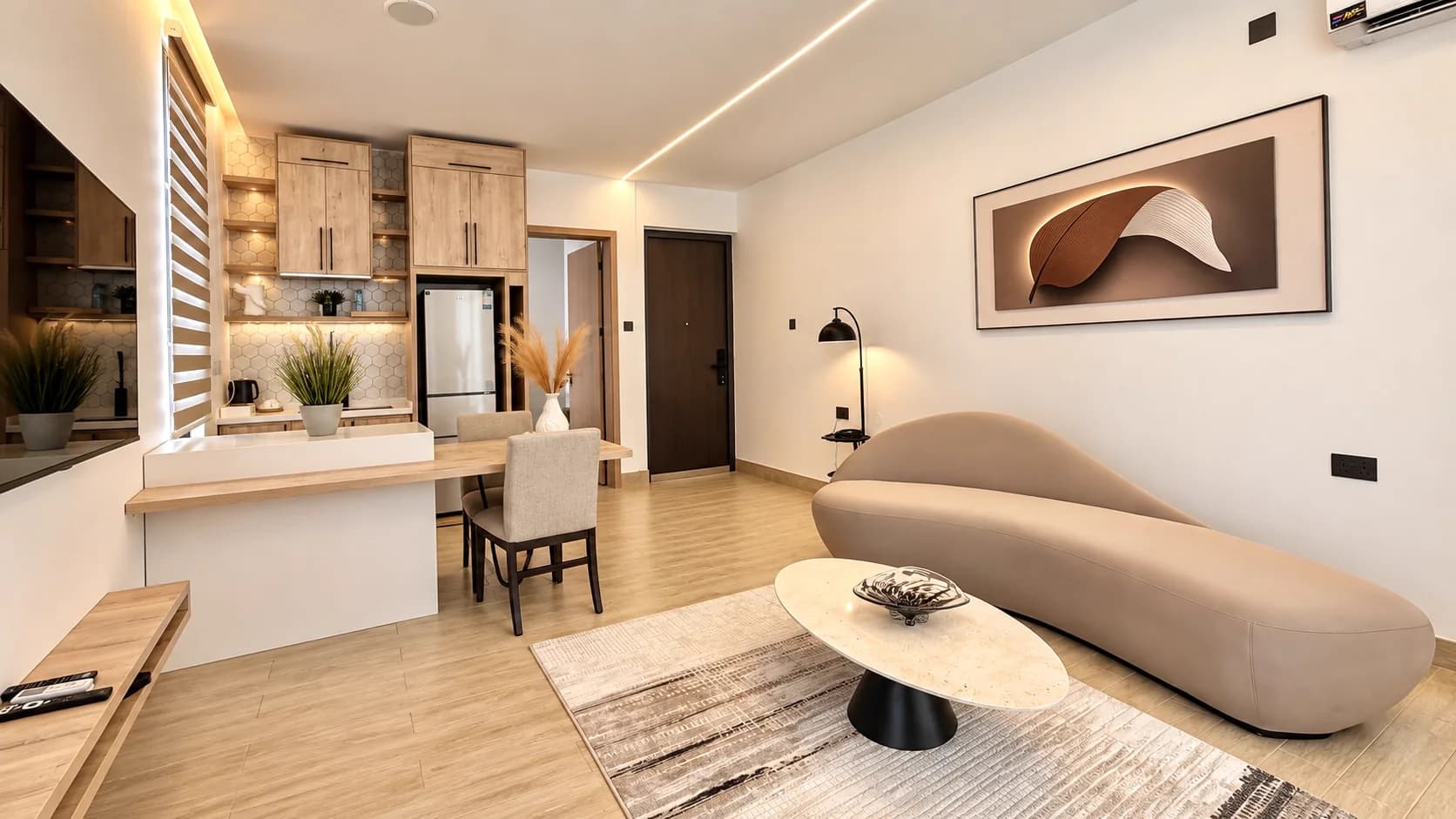
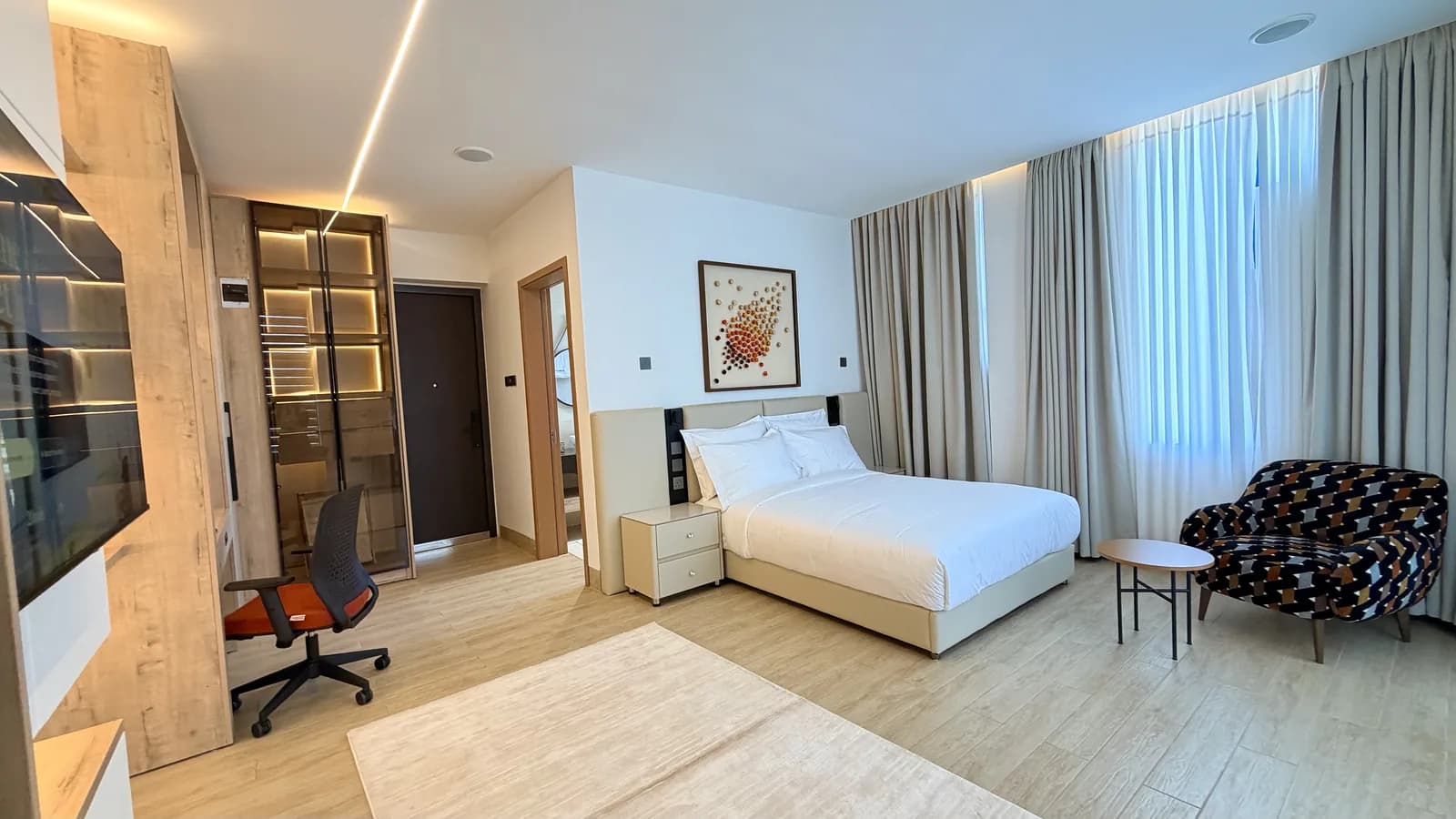
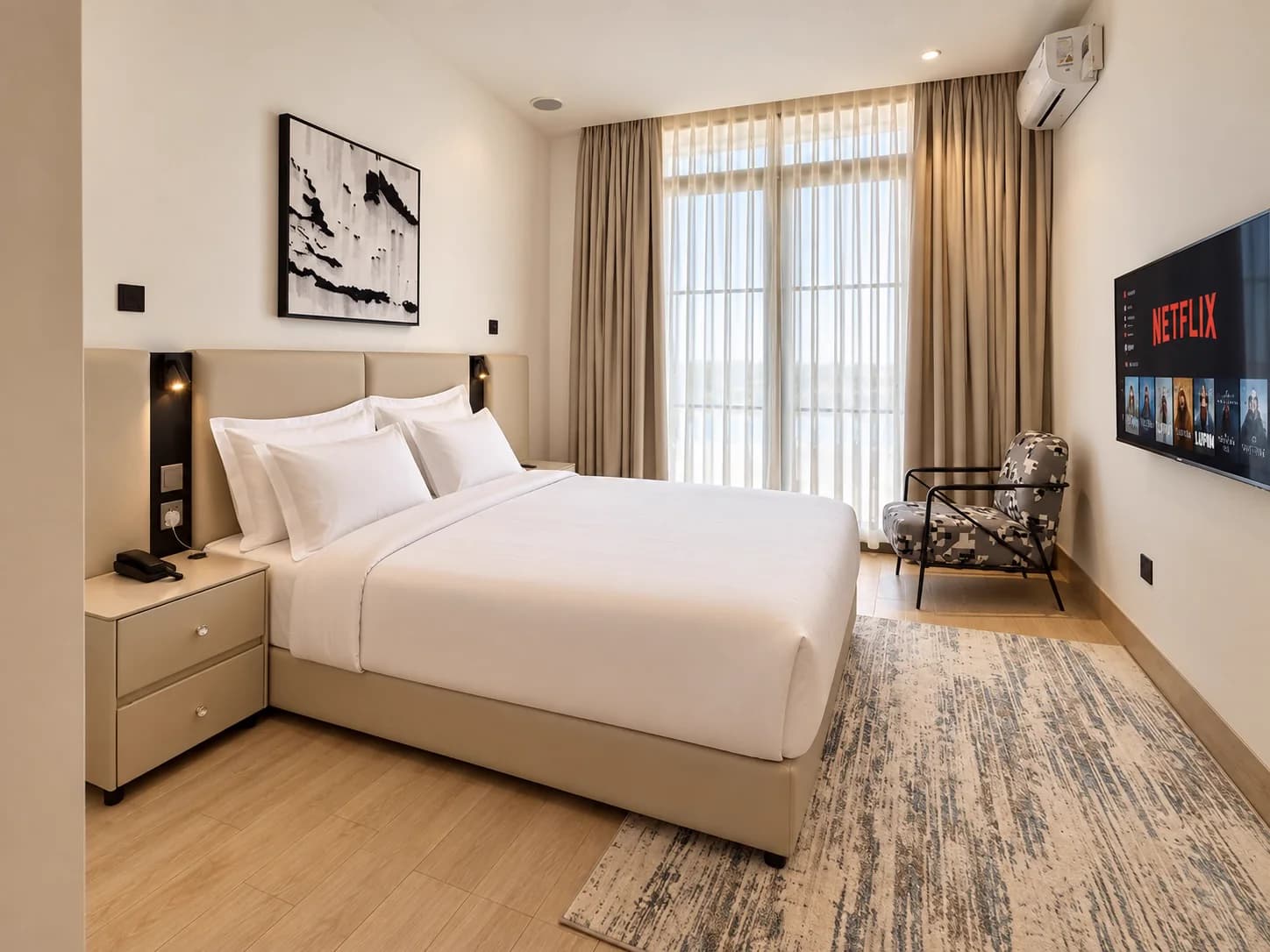
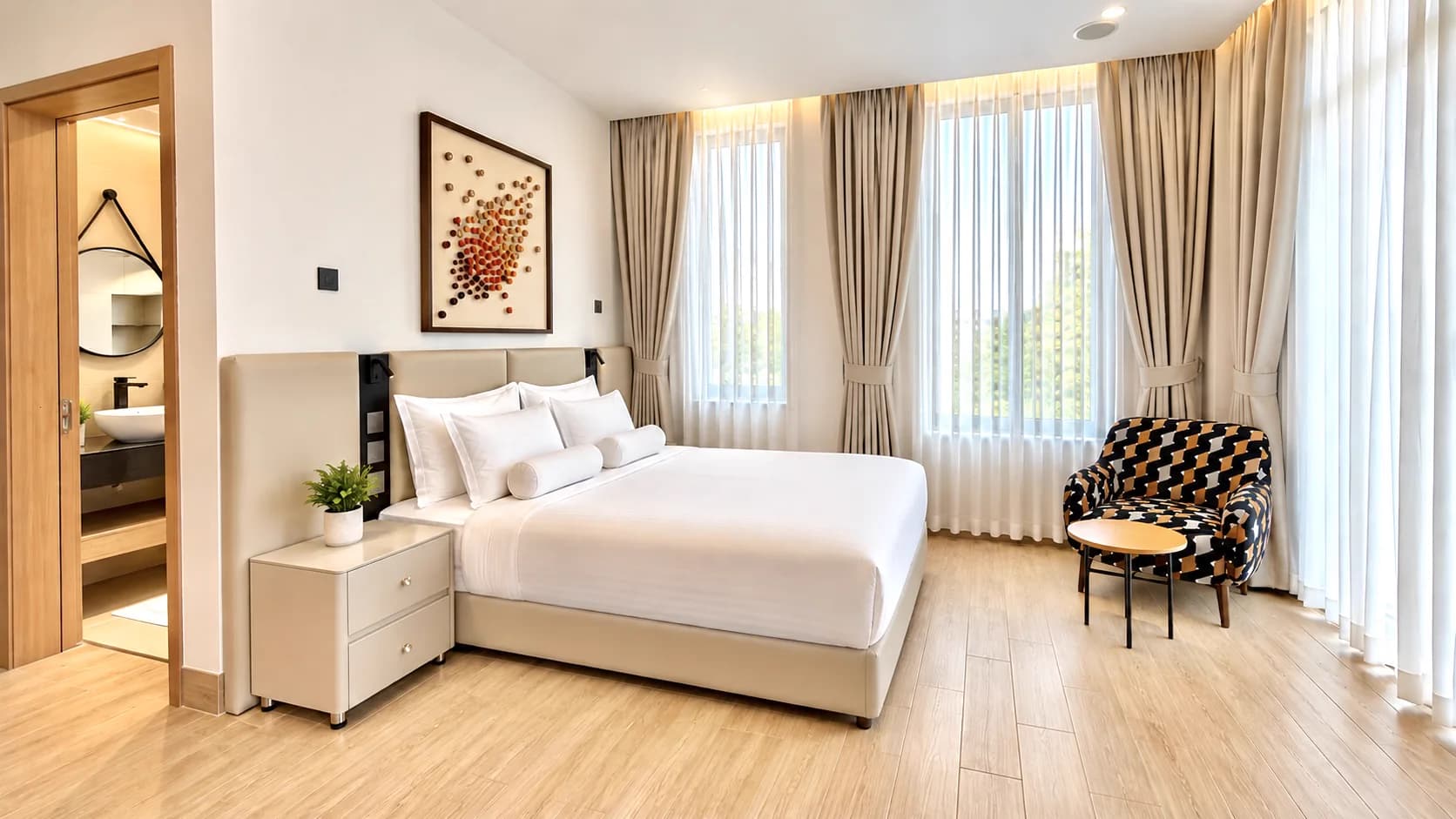
The 1BHK Suite at $115 a night is the default, because from 52 m² it puts the king bed behind a proper door and keeps the desk and lounge on the other side. That door is the difference between a late call being normal and a late call being a negotiation.
For one person on a stay of a week or less, the Studio Deluxe at $105 a night from 32 m² is genuinely sufficient: a queen bed, a writing nook with a real desk, a kitchenette and a balcony. It is the most efficient way to test whether working from Kigo suits you.
For two people who are both working, the 2BHK Suite at $200 a night from 88 m² is the comfortable answer, because two rooms can be in use at once and there are two bathrooms. It also has a fully stocked kitchen, which matters on a stay measured in weeks.
The 3BHK Penthouse at $300 a night, from 180 m² on the top floor, is the choice for a founder bringing family, or a small team using one apartment as a base. It arrives on Platinum activity tier, which folds in chauffeur service, championship golf and the Wellness Sanctuary spa.
One point of detail worth knowing before you book: the Studio Deluxe and the 1BHK have a kitchenette — kettle, microwave, fridge — while fully stocked kitchens are in the 2BHK and the Penthouse only. For a working stay where breakfast is included downstairs and dinner comes from the restaurant, a kitchenette is rarely the constraint. For a month where you want to cook, it is.
The full side-by-side comparison, including the long-stay arithmetic, is in our guide to the Penthouse and the suites. Rates are on the pricing page.
Where in Kampala should you base yourself?
Four areas account for almost all long-stay remote workers, and they suit genuinely different working patterns. Pick on the basis of how often you need to be in the city.
Kigo, on Kigo Road in Wakiso District, is lakeside and residential, directly adjacent to the Lake Victoria championship golf resort and about 20 km from Entebbe International Airport via the Entebbe Express Highway. Central Kampala is roughly 25 minutes. It suits executives who fly often, work from the apartment and go into town deliberately rather than daily.
Naguru and Bugolobi are residential and closer in, popular with the technology and development sectors, and a mix of villa rentals and small serviced apartments.
Kololo is the embassy district: polished, well served for dinner, and the most expensive per square metre. Better for a social stay than a focused one.
Nakasero is city-centre adjacent and busier, and makes sense if you are in face-to-face meetings every day rather than on calls.
The comparison most long-stay guests actually weigh is Kigo against Nakasero, and we have written it up properly in Kigo vs Nakasero: Kampala's luxury neighbourhoods. The area guide covers what is within reach of Kigo itself.
How do meals, laundry and housekeeping work on a long stay?
They are handled, which is the entire point of a serviced apartment over a rental. Breakfast is included with every stay, daily housekeeping is standard, and laundry is a service — housekeeping collects it and returns it, rather than you running a machine.
That matters more on week three than on day two. The failure mode of a long remote-work stay is not loneliness or bad Wi-Fi; it is domestic admin slowly eating the margins of the working day.
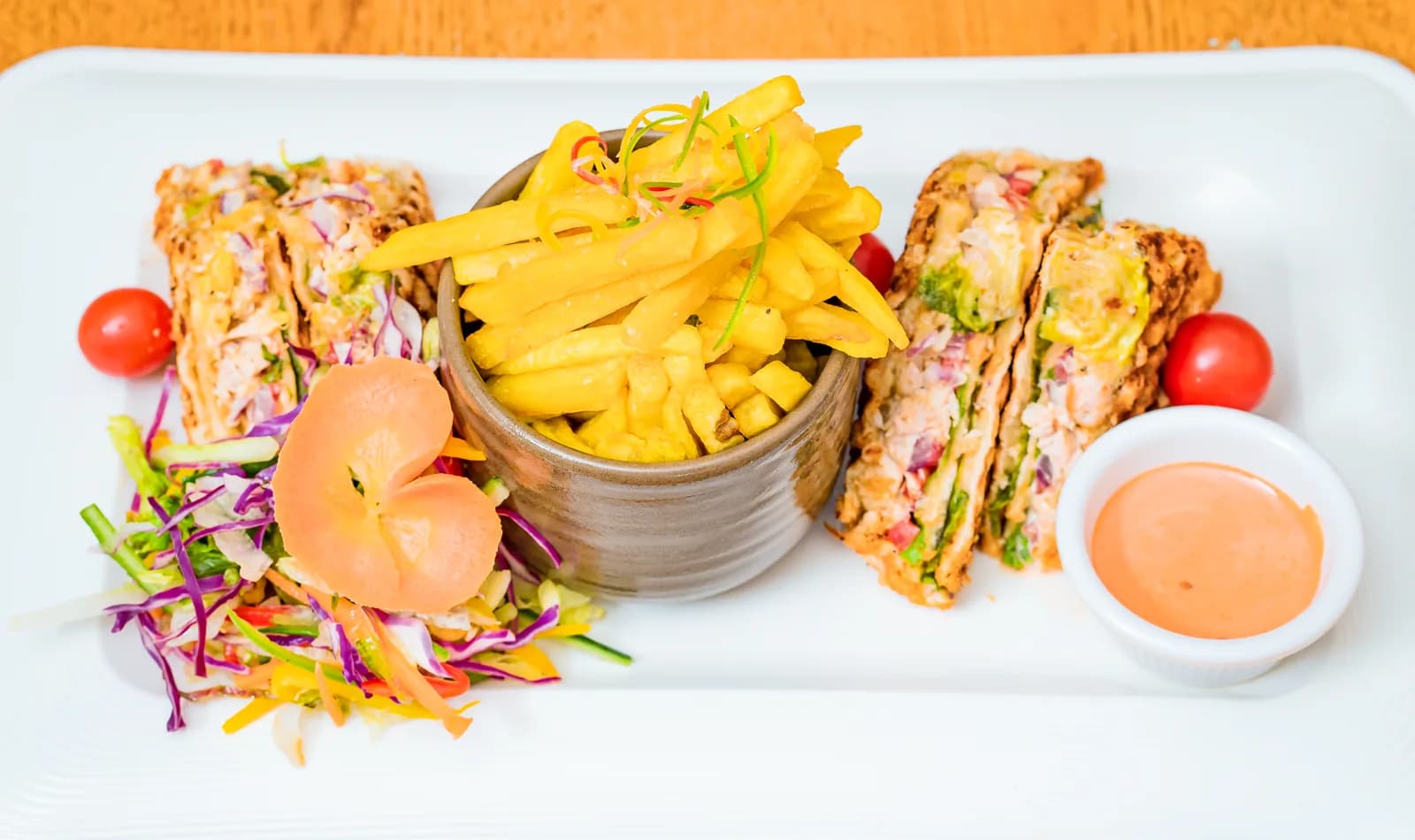
Lunch and dinner are à la carte from the ground-floor restaurant — grills, curries, pizza, pasta, salads, coffee and fresh juice — and room service brings any dish up to the apartment. On a heavy call day that is the difference between eating properly and eating whatever is nearest.
Two practical notes for long stays. Ask housekeeping to work around your call block rather than at a fixed hour — it is a two-sentence conversation with the concierge and it removes a daily interruption. And if you are staying a month, set a standing weekly spa appointment at the Wellness Sanctuary next door, because the thing long-stay guests regret is not booking it rather than booking it.
Facilities on site are listed on the facilities page; the concierge runs 24/7, as does armed security.
What does a working stay cost, and how do discounts work?
Stays of seven nights or more attract a discount of 10–20%, and extended-stay and long-stay rates exist beyond that for bookings measured in months. Because the discount is proportional, it narrows the gap between apartment types — the step up from a Studio Deluxe to a 1BHK Suite costs less per night across a month than across three nights.
That is the single most useful thing to know before you book a long stay. The rate card is written for short stays, and a four-week booking should never be priced from it.
The practical approach is to message the concierge on WhatsApp at +256 748 390 401 with your dates, your headcount and whether you want to cook, and ask for the long-stay quote. The office line is +256 393 101 080. Both will quote two typologies side by side if you are undecided.
For the comparison against short-let rentals, including what you give up on service and security, see HMK Living vs Airbnb in Kigo. For company-paid stays and standing corporate arrangements, corporate accommodation in Kampala covers the invoicing and account side.
What should you sort out before you fly?
Six things, none of them difficult, all of them annoying if left to the airport.
- Visa. The Uganda tourist visa allows 90 days and is issued through the official eVisa portal, with on-arrival issuance also available at Entebbe. For a stay crossing 90 days, look at the East African Tourist Visa or a business-visitor visa, and confirm with a Uganda mission.
- Plugs. Uganda uses the UK-style Type G socket at 240V. Bring two adapters, not one, because the second one always ends up behind the desk.
- A local eSIM or SIM. Fibre in the building is your primary connection; a mobile data line is your backup for the call you cannot drop. Airtel and MTN both sell data on arrival.
- Vaccination and health paperwork. Yellow-fever requirements apply for travel to Uganda; check the current rule with your clinic well before you fly, as the certificate is not instant.
- Your airport transfer. Entebbe is about 20 km from Kigo on the Entebbe Express Highway. Arrange the pick-up through the concierge before you land rather than negotiating at arrivals — the first-timer's guide from Entebbe to Kigo walks through the drive.
- Your first-week calendar. Block the first morning for setting up rather than for a call. Test the Wi-Fi, find the light, move the desk if you need to, and tell the concierge your working hours.
How should you plan the first stay?
Make it short. Ten days is long enough to test the connectivity, the time-zone fit, the food and the rhythm, and short enough that nothing is lost if the answer is no.
Book a Studio Deluxe or a 1BHK Suite, arrive on a Saturday so the first working Monday is not also your first day in the country, and run a normal week rather than a holiday. If the Wi-Fi holds through a stacked call afternoon and the mornings deliver the deep-work block, you will know by Wednesday.
The second trip is the one that matters. Most people who return come back for four to six weeks and take a larger apartment, because by then they know whether they want a kitchen and whether they want a second room.
The work-from-Kampala case is not universal. It works for people who want European and Gulf time-zone overlap, who can do their job from an apartment, who value quiet over nightlife, and who like being 20 km from an international airport without living in a city centre. For that profile, Kigo in 2026 is one of the more interesting under-priced bases anywhere, and the infrastructure has quietly caught up with the idea.
Start on the reservations page, read the guide to hotel accommodation in Kigo for the wider neighbourhood picture, or send the concierge your dates and your working hours and ask what the long-stay rate looks like.
Reserve your stay at HMK Living, Kigo.
A curated boutique apartment. Direct rates, real-time availability, and an agentic WhatsApp concierge that handles the rest.
Planning a trip? Read our guide to hotel accommodation in Kigo.
Hajrah is the founder of HMK Living and the architect of the project's quiet-luxury brief in Kigo, Kampala. She writes about luxury hospitality, residential design, and life on the lakeside.
Common questions about this topic.
Yes, for the right kind of remote worker. Uganda's working language is English, the time zone is UTC+3 with no daylight saving, and fibre-optic internet has improved substantially since 2022. The variable that decides the trip is not the country but the desk: a hotel room with a writing shelf is not a workspace, and an apartment with a proper desk and mesh Wi-Fi is.