The Best Time to Visit Kigo and Lake Victoria: A Seasonal Guide
An equator-and-altitude climate means Kigo has no bad season, only different ones. A month-by-month guide to weather on the northern shore of Lake Victoria, the two rainy and two drier spells, when rates and crowds ease, and exactly what to pack.

Most destinations have a season you should visit and a season you should avoid. Kigo does not, and the reason is geography: Uganda sits almost exactly on the equator but at altitude, which produces warm days, cool nights and remarkably little variation across the year.
What changes here is rainfall, not temperature. There are two rainy seasons and two drier spells, the rain tends to arrive in heavy bursts rather than settling in for the day, and Lake Victoria moderates the air around Kigo on the northern shore. This guide goes through the year month by month, says plainly when rates and crowds ease, and ends with a packing list you can work from.
When is the best time to visit Kigo?
June to August, if you want the single most comfortable window, followed closely by December to February. Those are the two drier spells, when the ground is firm for golf, boat departures are rarely postponed, and a full day outdoors needs no contingency plan.
June to August is the connoisseur's answer. The air is cooler, the afternoon storms are infrequent, and the lake is at its calmest for early departures. December to February is drier still in parts but warmer and brighter, which suits anyone coming for the water and the course rather than long drives.
The important caveat is that the alternative is not bad, merely different. In the rainy months of March to May and October to November, you get clear mornings, a sharp afternoon downpour, green landscapes, cleaner air and a quieter calendar. If your itinerary tolerates an indoor afternoon, these are the months when a Kigo stay is at its best value.
What is the weather actually like in Kigo?
Warm by day, cool after dark, and much the same in March as in September. The equator sets the temperature and the altitude takes the edge off it, so the year reads as a series of rainfall patterns rather than as summer and winter.
Four features define it:
- Two rainy seasons. Roughly March to May, the heavier of the two, and roughly October to November, which is shorter and lighter.
- Two drier spells. Roughly December to February and June to August.
- Rain in bursts. A downpour here is typically half an hour to two hours of intense rain, often in the afternoon or evening, rather than an all-day grey. Mornings are frequently clear even in the wettest weeks.
- A lake effect. Lake Victoria moderates the temperature around Kigo and supplies a breeze that central Kampala does not get. It also generates its own weather, so storms build over the water quickly in the afternoon.
Two further things catch visitors out. Daylight is almost constant — roughly six in the morning to six in the evening all year — so there are no long light evenings to plan around, and sunset is abrupt. And the equatorial sun is strong between showers whatever the month, which is why sunscreen belongs in the same pocket as the rain shell.
What does the year look like month by month?
Here is the whole calendar in one place, with what each month is actually like and what it suits. Treat it as a pattern rather than a forecast — any given year shifts the edges of a season by a few weeks.
| Month | Pattern | Crowds | Best for |
|---|---|---|---|
| January | Dry spell, bright and warm | Busy early, easing late | Golf, lake days, families |
| February | Driest stretch for many years, warm | Moderate | Golf, business, boat trips |
| March | First rains arrive, usually late in the month | Quieter | Business, value stays |
| April | Wettest month on average | Quietest | Value, spa, working stays |
| May | Rains tailing off, very green | Quiet | Value, photography, birds |
| June | Dry spell begins, cooler air | Building | Golf, walking, long days out |
| July | Comfortable and dry, northern-summer peak | Busy | Families, golf, everything |
| August | Dry and cool, still busy | Busy | Families, lake, golf |
| September | Transitional, warm with building showers | Moderate | Business, shoulder value |
| October | Second rains, lighter than April | Quieter | Value, spa, short trips |
| November | Rains easing through the month | Quieter | Value, green landscapes |
| December | Dry spell returns, festive peak late | Very busy late | Festive stays, groups, golf |
Three notes on reading that table. The rainy seasons shift year to year, so March can stay dry and May can run wet. The crowd column tracks international demand rather than the weather, which is why busy July is also comfortable July. And business demand runs on an entirely different calendar, covered further down.
What are the rainy seasons really like?
Less disruptive than the word "rainy" suggests, and far more pleasant than a temperate wet season. The pattern on this shoreline is a clear or hazy morning, heat building towards midday, a dark build over the lake, then an intense downpour that empties the sky and leaves the evening washed and cool.
Practically, that means you plan outdoor activity for the morning and keep the afternoon flexible. An early tee time, a dawn boat, a morning drive to Entebbe — all of these work in April. What does not work is a two-hour outdoor lunch at one in the afternoon in the wettest fortnight of the year.
Two things genuinely change in the rainy months. Unsurfaced roads and paths get slippery, which matters for places like the Mabamba Bay shoebill swamp, so closed shoes with grip earn their space in the bag. And boat departures are postponed more often, which is the operator being competent rather than the day being ruined.
The compensations are substantial. The landscape is at its most intensely green, the dust is gone from the air, birdlife is at its most active, the attractions are quiet enough to feel private, and the accommodation calendar has room in it. A week in May is a different holiday from a week in July, not a worse one.
When are rates and crowds lower?
Inside the two rainy seasons, plus the fortnight or so after the festive peak clears. March to May is the deepest quiet stretch, October to November the second, and late January into early February is a brief and often overlooked window.
The demand peaks, for contrast, are predictable:
- Mid-December to the first week of January. The festive season, the busiest stretch of the year, and the one that needs booking furthest ahead.
- July and August. The northern-summer holiday window, which fills family-sized apartments first.
- Easter. A short, sharp regional peak that moves with the date each year.
Two levers matter more than the season. Stays of seven nights or more attract a 10 to 20% discount, which usually outweighs any seasonal variation — a long stay in a busy month can land below a short stay in a quiet one. And website bookings carry free cancellation up to 48 hours before check-in, with payment settled on arrival, so booking early to secure the apartment you want costs very little in flexibility. Current rates are on the pricing page.
The booking lead times that work: two to three months for Christmas, New Year, Easter and the July to August window, particularly for a 2BHK Suite or the 3BHK Penthouse; two to four weeks in the shoulder and rainy months.

What is the best season for golf in Kigo?
June to August first, December to February second. Firm ground, fewer afternoon storms and cooler air make these the months when the championship course adjacent to HMK Living plays at its best and a round finishes when you expected it to.
The course is playable through most of the year, though, and the tactic in the wetter months is simply timing. Take a tee time before seven, be off the course by late morning, and treat the afternoon as the spa's problem rather than the course's. Expect the occasional suspension for lightning in the rainy seasons, which is a safety decision taken by course staff.
A few seasonal details are worth knowing. The grass is at its lushest in the weeks after the long rains, which rewards the ball-striker and punishes the hacker. Fairways are fastest and most forgiving in the June to August dry spell. And twilight golf is reliably good all year, because sunset barely moves.
How a stay-and-play week is usually assembled — tiers, tee times, what is included — is set out in the golf and stay guide. Golf is included from Gold tier upwards, which is the default on the larger apartments.
When should you come for the lake, wildlife and day trips?
For the lake, the drier spells and the ends of the day. For wildlife and the long drives, the dry months again, because unsurfaced access roads are easier. For birds, the rainy months are better than the dry ones, which is the one place the pattern inverts.
- Boat trips and sunset cruises. Best at dawn for calm water and in the hour before sunset for light, in any season. Avoid the middle of the day, which is hottest and most likely to produce a storm over the water.
- Fishing charters. The drier spells, when the lake is flattest and departures hold. You will be an hour from shade, so a hat is not optional.
- Ngamba Island chimpanzees. Any month, with an early boat. Visitor numbers are capped, so book at least 48 hours ahead and expect weekends and the July to August window to fill first.
- Mabamba Bay shoebill swamp. The rainy months are good for birdlife generally, but the approach tracks are much harder, so the dry spells are the safer plan for a half-day trip.
- The Entebbe Botanical Gardens and the Wildlife Conservation Education Centre. Mornings, year-round. Under mature trees, a shower is an event rather than a problem.
- The Equator monument at Kayabwe. Mid-morning, any month, about forty minutes away on a surfaced road.
All of these sit inside about an hour of Kigo Road, and all of them are bookable through the concierge. The full radius, ranked by how much of a day each takes, is in things to do near Kigo.
When is the best time for business travel to Kampala?
February to March and September to November. The Ugandan business calendar is fully active in both windows, which matters more for a working trip than the weather does, and neither is thinned out by a holiday season.
The two stretches to avoid are the fortnight either side of Christmas, when offices wind down and decisions wait for January, and the second half of August, when many senior people are away. A trip in those weeks is not wasted, but it tends to produce fewer meetings than the calendar promised.
Kigo works for these trips regardless of season because the logistics do not change with the weather. The airport is about 20 km away via the Entebbe Express Highway, central Kampala is roughly 25 minutes, every apartment has a work desk on fibre-optic mesh Wi-Fi, and the restaurant downstairs covers breakfast — included with every stay — then lunch and dinner à la carte, with room service for a late finish.
One seasonal note for anyone taking calls across time zones: the rains do not meaningfully disrupt fibre here, but a heavy storm can coincide with a power event, so keep laptops charged in the rainy months rather than running them to five per cent before a call.

What should you pack for Kigo?
Light clothes, one warm layer, a rain shell and sun protection — in that order, in every month of the year. The two fixed facts of this climate are that evenings are cool and that rain can arrive whatever the season, and almost every packing mistake here comes from ignoring one of them.
Clothing
- Light, breathable daytime clothing in natural fabrics.
- One warm layer — a fleece, a light jumper or a jacket — for the evening and for early starts.
- Long sleeves and long trousers for dusk, which is when mosquitoes are active.
- A packable rain shell, in any month. Not an umbrella, which loses to equatorial wind.
- Closed shoes with grip for wet paths, plus whatever you like for the daytime.
- Smart-casual for dinner. Modest dress for the Munyonyo Martyrs Shrine and other places of worship.
- Golf shoes and gloves if you intend to play; club hire is available next door.
- Swimwear only for the spa next door, as there is no swimming pool at HMK Living.
Health and sun
- High-factor sunscreen and a wide-brimmed hat. The equatorial sun is strong between showers.
- Sunglasses, which matter more on the water than on land.
- Insect repellent with DEET, and your malaria prophylaxis discussed with a travel clinic before you fly.
- Your own regular medication in original packaging with a copy of the prescription.
- A small first-aid kit with rehydration salts.
Documents and equipment
- Passport, Ugandan visa approval printed, and your yellow fever certificate.
- Travel insurance details including medical evacuation cover.
- A universal adaptor for Type G sockets at 240 volts, plus a power bank.
- A dry bag or waterproof phone pouch for boat trips.
- Some cash in shillings for markets, guides and tips, alongside cards.
One packing decision this climate makes for you: pack for about four days whatever the length of the stay. Laundry at HMK Living runs as a service — collected, washed, ironed and returned — because there are no washing machines in the apartments, and a long stay on a small suitcase is the normal pattern here rather than the exception.
Does the season change which apartment you want?
Mildly, and mostly through how much time you expect to spend indoors. A rainy-season stay is more of an in-apartment stay, which argues for space, a separate lounge and a kitchen; a dry-season stay built around golf and the lake can be run from a smaller room you barely sit in.
| Apartment | From | Size | Beds and baths | Kitchen |
|---|---|---|---|---|
| Studio Deluxe | $125 | From 32 m² | 1 queen | Kitchenette |
| 1BHK Suite | $140 | From 52 m² | 1 king | Kitchenette |
| 2BHK Suite | $200 | From 88 m² | 2 kings, 2 baths | Fully stocked |
| 3BHK Penthouse | $300 | From 180 m² | 3 kings, 3 baths | Fully stocked |
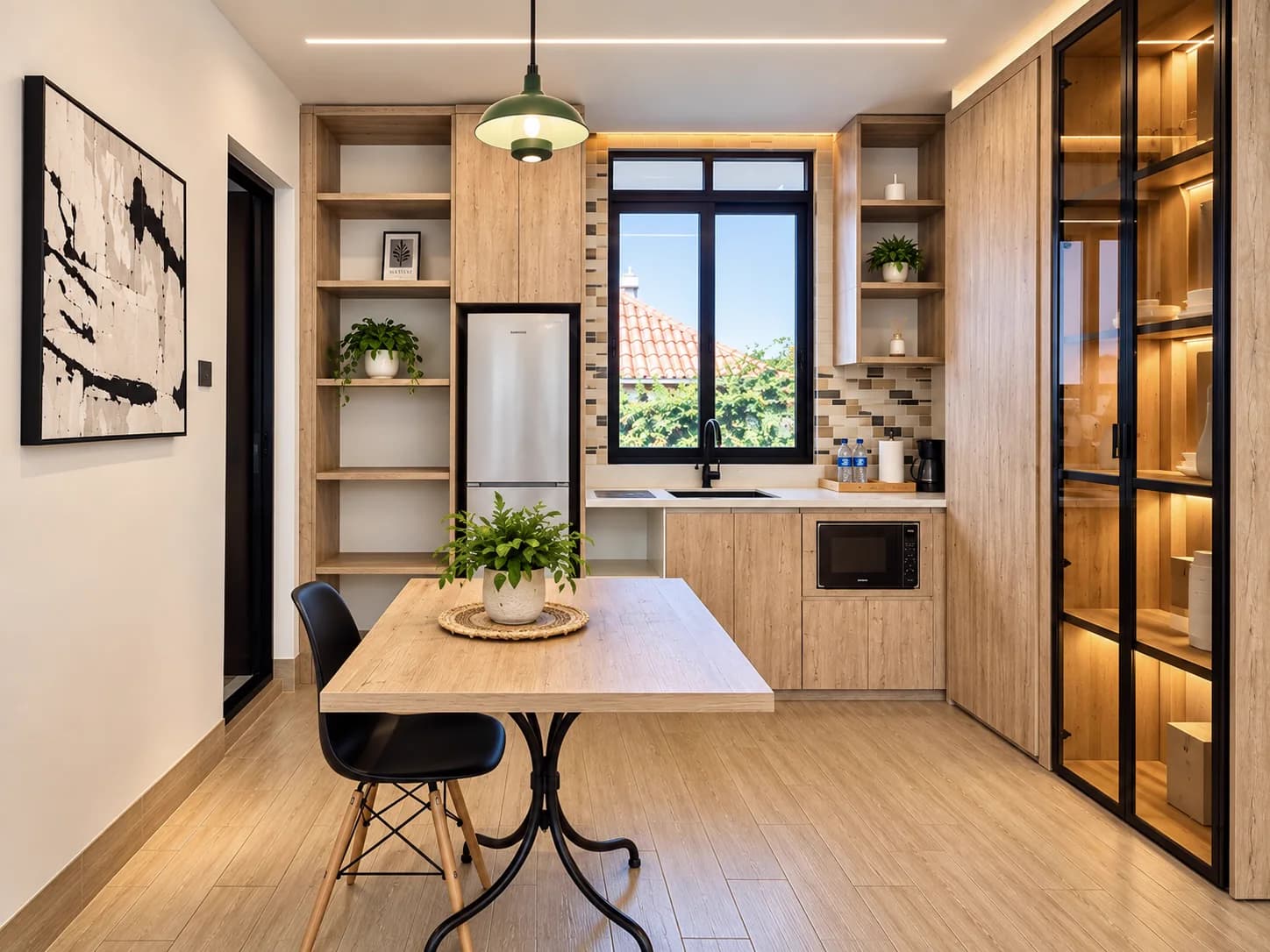
Be precise about kitchens, because it is the detail that changes a wet-afternoon stay. Full kitchens are in the 2BHK Suite and the Penthouse only; the Studio Deluxe and the 1BHK Suite have a kitchenette with a kettle, a microwave and a fridge, which covers coffee before a dawn tee time and a light supper but not dinner for four.
The rest is constant through the year: breakfast included with every stay, daily housekeeping, laundry as a service, fibre-optic mesh Wi-Fi and a desk in every apartment, 24/7 armed security on site, a 24/7 guest concierge and airport transfers arranged for you. The full list is on the facilities page, and the terms are on the house rules page.
So when should you book?
If you want certainty, come between June and August or between December and February, and book two to three months ahead. If you want value and quiet, come in April, May, October or November, book two to four weeks ahead, and plan your outdoor hours for the morning.
If you are coming for work, aim at February to March or September to November and ignore the weather entirely — it will not change your meetings, and the apartment has a desk. If you are coming for the golf, take the June to August window and a six-thirty tee time.
The broader point about this corner of the world is that the season is a preference rather than a constraint. Kigo sits on the northern shore of Lake Victoria between Kampala and Entebbe, about 20 km from the airport on the Entebbe Express Highway and roughly 25 minutes from the city, with the championship golf resort adjacent and the wellness spa next door. That arrangement works in the rain as well as in the sun — the itinerary simply moves an hour earlier.
Stays of seven nights or more attract a 10 to 20% discount in any month, which is the single largest lever on what a trip costs. If your dates are flexible and your stay is long, a wet week is often the best booking on the calendar.
Check your dates and reserve, see what is on the menu on the restaurant page, or read the pillar guide to hotel accommodation in Kigo. The neighbourhood is mapped on the area guide, the arrival is explained in the first-timer's airport guide, and the WhatsApp concierge on +256 748 390 401 or the office line on +256 393 101 080 will tell you honestly what the weather has been doing this week.
Reserve your stay at HMK Living, Kigo.
A curated boutique apartment. Direct rates, real-time availability, and an agentic WhatsApp concierge that handles the rest.
Planning a trip? Read our guide to hotel accommodation in Kigo.
The HMK Living editorial team — covering hospitality, travel, and life around Kampala's lakeside. Articles are reviewed by the founding team for accuracy on local detail.
Common questions about this topic.
The two drier spells — roughly December to February and June to August — are the easiest for golf, boat trips and long days out, because the ground is firm and departures are rarely postponed. June to August is the most comfortable of all, with cooler air and fewer afternoon storms. That said, Uganda sits on the equator at altitude, so no month is genuinely off-season: the rainy months bring heavy bursts rather than all-day rain, plus greener landscapes and quieter calendars.